Back to selection
The Gotham Pages: Tessa Thompson on the Pleasures of Playing the Villain
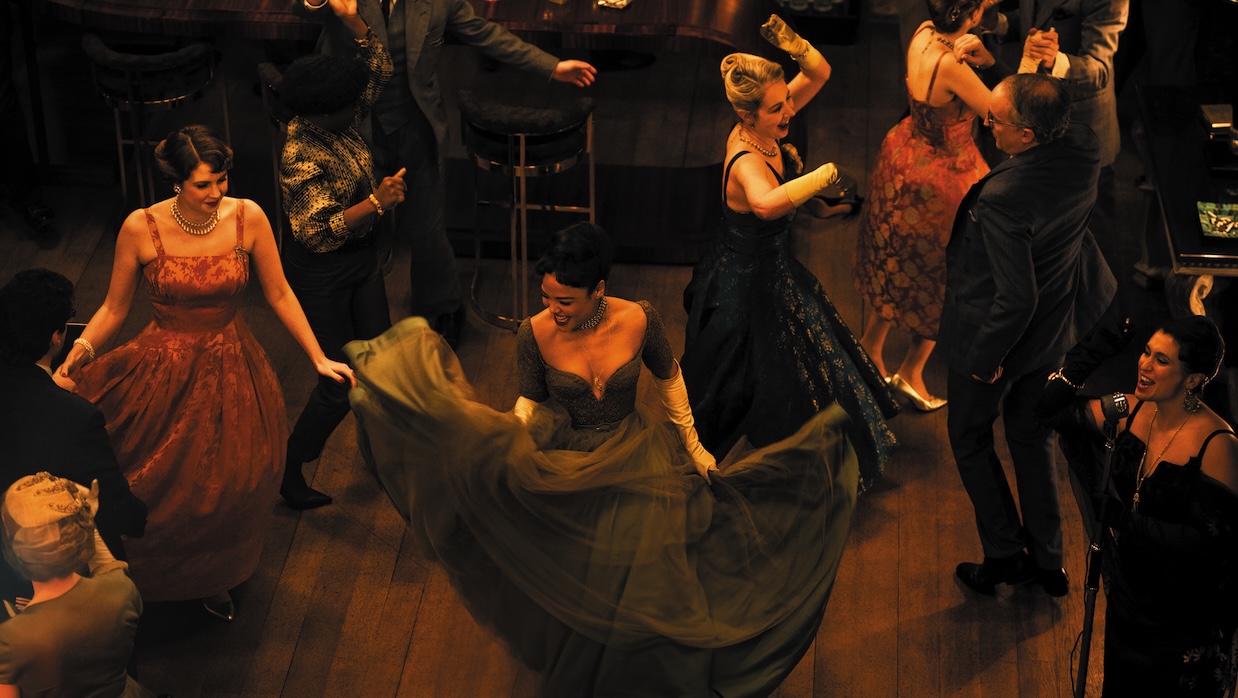 Tessa Thompson in Hedda
 Tessa Thompson has a predilection for playing fiercely ambitious women. Against all odds, her characters stand firmly in their politics, like Sam in Justin Simien’s Dear White People (2014). Other times, they persevere despite cycles of poverty and nefarious circumstances, like Ollie in Nia DaCosta’s directorial debut, Little Woods (2018). These are women who tend to get what they want. But in DaCosta’s latest film, Hedda (2025), Thompson reveals the more sinister faces of human desire.
The period film, which reimagines Henrik Ibsen’s play, Hedda Gabler (1891), is set in 1950s England and follows newlywed Hedda Tesman (Thompson), the mixed-race daughter of a wealthy general, over the course of one night. Her husband, George Tesman (Tom Bateman) is interviewing for a tenured position at his university, so they host a splashy party in their too-large English manor to impress his colleagues.
But the stakes get higher when Hedda’s former lover, Eileen Lovborg (Nina Hoss), arrives at the party with news that threatens George’s chances for success. Hedda, determined to course correct throughout this delirious, fever-dream of an evening, works the room like she’s playing a game of chess—each guest but another pawn in her quest for power. Thompson’s performance is arresting and has already earned her a nomination for Outstanding Lead Performance at the 35th Annual Gotham Film Awards, where she will also receive a Spotlight Tribute for her role. Ahead of the ceremony, I chatted with Thompson about inhabiting this tempestuous literary character—a role she embodies with razor-sharp command and intoxicating grandeur.
Daniella Brito: You began your career on the stage, playing Shakespearean figures like Ariel in The Tempest and Juliet in Romeo and Juliet: Antebellum New Orleans, 1836—for which you earned an NAACP Theatre Award. Can you tell me about your approach to the stage versus the screen?
Tessa Thomspon: Each medium has its own unique challenges. Working with the cast in Hedda reminded me of working with an ensemble. We were able to have multiple weeks of rehearsal together on set, which made it feel more like theater. We also desired that the piece itself feel theatrical—there’s a bigness to our performances that is more akin to how a company might approach a work on stage.
I started my career in really small theaters, and when you’re working at that scale you’re not mic’ed; you’re closer to the audience. At any scale, you’re hopefully trying to find an emotional truth inside of the world that you’re creating, and this can vary in size depending on the scope of the world. So, I think every approach is bespoke, and that’s the really beautiful thing about making things across mediums.
DB: Absolutely. Thank you for bringing us to the realm of the interior. As a canonical character in theater, Hedda is often likened to Hamlet because of her use of deceit and manipulation to meet her desires. Can you describe your experience portraying a protagonist with a villainous arc?
TT: When you’re playing a villain you have to empathize with them. From a villain’s point of view, there’s always a really good reason for the harm they incite. There is, of course, something Machiavellian about Hedda’s actions. But I was particularly drawn to the part of Hedda [who] made moment-to-moment choices without much caution around their consequences.
It’s something that I think Nia [DaCosta] wrote really beautifully in this piece. There’s an impulsivity to Hedda; Nia describes it as “acting on her intrusive thoughts.” I think we all have these intrusive thoughts that come from unsavory places—jealousy, envy or frivolity—sentiments that we don’t like to think rule our actions. These feelings might be the source of some of the villainous things that Hedda does, although I don’t think she would think of them in that way.
While she acts on these darker impulses, she has to reckon with her choices throughout the night, and I find that some of the reasons for her decisions are even a mystery to herself.
I think there’s something pleasurable about playing someone like that—someone [who’s] a real live wire—because we’re socialized not to act on all the things that spring to our mind. I needed to find an emotional logic for Hedda’s behavior, and I found that it’s rooted in a deep feeling of powerlessness. Sometimes, that feeling can animate you into action, and often those actions don’t reflect the best of us.
DB: Absolutely. There is so much messy power play in this film, and it’s really exciting to watch it all unravel on screen. To quote Eileen in the film, where do you think that Hedda derives her power? She moves through the largely white and upper class world that surrounds her with tact.
TT: I think she’s playing a game to discover her proximity to power. She codeswitches, using what’s available to her to gain access to power: her wit, her charm, her cunning, her feminine wiles. She has a really adept sense of people and knows how to manipulate them. But I don’t think she feels a real sense of personal power. One of the things that Nia and I were really interested in exploring here was the ways in which denying our own personal power can pervert us.
Hedda is a woman who, for all intents and purposes, presents as powerful, takes up a tremendous amount of space in the room but ultimately feels pretty powerless. And I think she’s someone who’s filled with a lot of desire—she desires to control. In Ibsen’s original work, Hedda professes her desire to manipulate a man’s destiny; “I want for once in my life to have the power to mould a human destiny,” she says. But I think this Hedda is a portrait of a woman who wants to be in control of her own destiny; yet, as Eileen suggests, is too cowardly to do so.
DB: Can you say more about Hedda’s relationship with Eileen? How would you describe the role that lesbian desire plays in Hedda’s life? What do you think Eileen symbolizes for her?
TT: I love that question. I think in a way, the lesbian desire here is a projection of a missed opportunity for real love between these two. I think Eileen is a true match for Hedda, and in some ways, she’s a foil to Hedda—she’s a woman who does not allow herself to be hemmed in by a time but goes into the world really trying to stake her claim in it on her own terms.
In the 1960s, social conditions were such that a woman could be feminine, using her beauty to get by, or serious, primarily relying on her smarts. In this film, Nia turns that binary on its head and studies the consequences of cutting off parts of oneself. So, Hedda and Eileen’s love is bittersweet; it’s a losing game for both of them.
DB: Do you think that there’s a power to be gleaned from longing?
TT: I think so—longing but also hunger. It really strikes me how hungry these women are inside of this piece. We see less of this in female protagonists—the kind of longing that might drive you to great lengths.
But I think Nia wanted to uncover the subtextual in the original Ibsen play, particularly when it came to longing and, quite frankly, kink. In the original text, Hedda makes these remarks that are [fraught] with innuendo, constantly coughing around longing and sex. Nia wanted to bring that into the action. This is what you see across this raucous party, which I think is just so delightful and delicious.
DB: Definitely. Are there elements of Hedda’s character that you think will stay with you off set?
TT: I think that when you’re playing a character that is “villainous,” you’re playing inside of the character’s shadow self. With Hedda, I wanted to find the spontaneous side of her, and I often feel like children really inhabit this.
Children are capable of such curiosity and kindness but also cruelty at times. Still, we always assume their innocence. Before children are socialized, they don’t interpret their impulses as “bad.” And so, I was interested in approaching Hedda with the tenderness that I might give to a child when they do things that can be mystifying.
This gave me real license and permission to investigate some of the murkiness that exists in me. We tend to worry about how people perceive us, but in many ways, this cuts off our humanity. I might, perhaps, have access to rage in a new way if I weren’t so concerned about what I thought it meant about me.
It’s this awareness of perception that limits our capacity to feel things that we think of as malignant—jealousy, anger, greed or ambition. But these can be really gorgeous parts of our humanity, too, and I read Hedda as a woman who really suffers from this. She’s grappling with her shadow self. For me, embarking on a nonjudgmental investigation of Hedda set me free to observe these kinds of traits within myself without critique—and in many ways, that was healing and cathartic.