Back to selection
Minnesota Fierce: Documentary Filmmaker Joua Lee Grande Reports From Operation Metro Surge
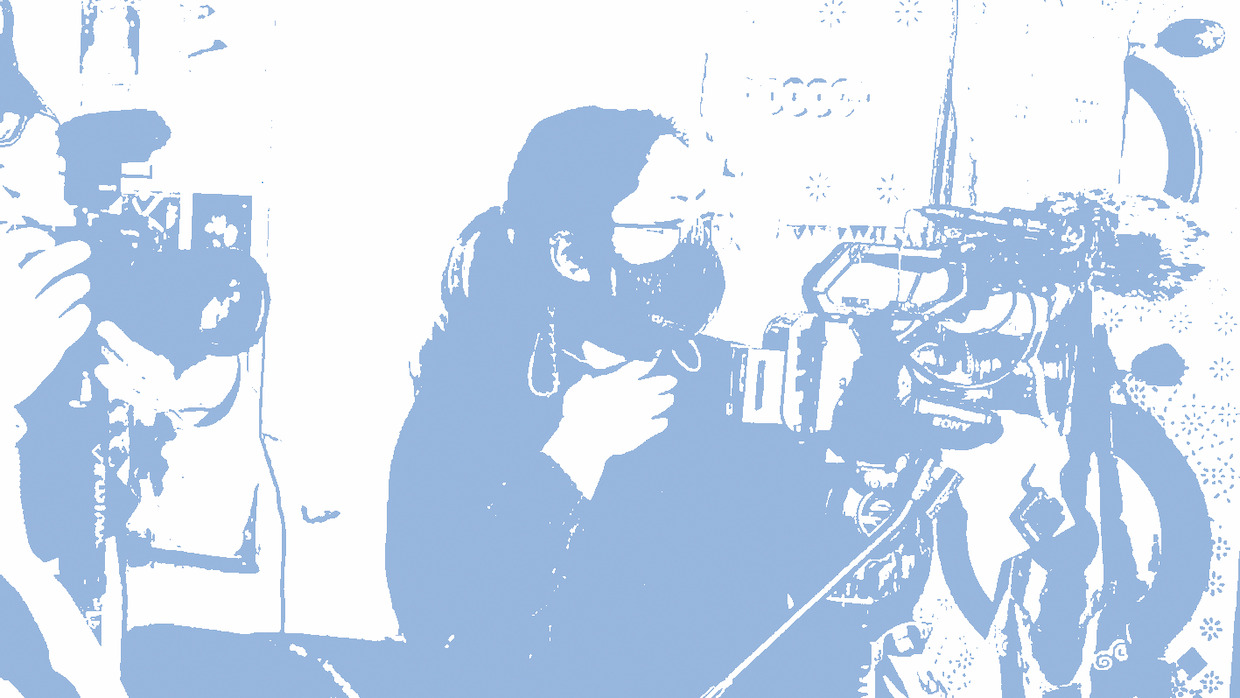 Image: Kazua Melissa Vang & Sheng Elizabeth Lor
 Though Joua Lee Grande studied cinema and media culture in college, she built much of her early career in nonprofits based in the Twin Cities. “I was mentoring young people about how they should follow their dreams, and I was like, I should take my own advice,” says Grande. “You’ve got to walk the walk at some point.”
In the years that followed, Grande established herself as a documentarian with a vital foothold in Minnesota’s underrepresented communities. Her films include On All Fronts, a short documentary about a Black-Indonesian family navigating the chaos of living in Minneapolis in 2020, and Teb Chaw (Land), an exploration of how Hmong American farmers have changed food culture in Minnesota.
Grande has a keen and intuitive sense of what might make a powerful and important film—though her role as a community organizer also ensures that she’s aware that casting light on a targeted group can be dangerous. “I’m so rooted in community, and I see so many amazing stories, stories that other people don’t seem to care about,” says Grande. “But I feel like, Oh my gosh, there are so many stories that are so fascinating and beautiful and lovely. It’s always a matter of, Someone should tell this story. Maybe me.”
But the sheer aggression of Operation Metro Surge—the Trump administration’s name for the 2,000-plus ICE agents, dispatched by the Department of Homeland Security, to occupy the Twin Cities—has posed unforeseen challenges both personal and professional. Below, Grande reflects on the role of an independent documentary filmmaker during unprecedented times.
Filmmaker: How did you get your start in documentary filmmaking?
Grande: I studied cinema and media culture in college, but I ended up working in nonprofits for a long time—so, the majority of my work has actually been direct community work. Everything from connecting under-resourced families to mentoring youth. A lot of that, I think, has very much informed my film work.
Filmmaker: Let’s talk about Teb Chaw (Land), your short documentary about Hmong farmers in Minnesota. How did that story come about?
Grande: With documentaries—most of the time—it’s never the story you set out to tell. As you get to know real people, they reveal things that take you by surprise. The arc of the story might change, or the heart of the story might change.
Usually, I like to do pre-interviews—but with Hmong elders, it’s really difficult to plan. So [with our primary subject], we were taking a huge risk: We’ve never met this person. We don’t fully know their story, we don’t know what we’re going to get, let’s just roll with the punches. I asked him, “Did you farm back in Laos?” And it took us by surprise that he was a child soldier. That was not something we were expecting, but we knew we would need to provide some historical context—so even though the film isn’t about farmers being veterans, that gave us a way [to tell that part of the story].
Filmmaker: You’re obviously deeply rooted in the Twin Cities, which is currently being targeted by ICE’s Operation Metro Surge. What do you see as the role of documentary filmmaking during this time of crisis?
Grande: A lot of filmmakers, especially BIPOC filmmakers… when these things are actively affecting our communities, 99 percent of the time we’re not thinking, Oh, here’s an opportunity to further my career. We’re putting the camera away and going, “I’m a community member first.” But you’re, of course, also thinking: How can film be something that helps my community? If we’re seeing that information is not being shared accurately, or if there are certain communities that are being affected that aren’t being covered by the press, we can tell their stories.
I’m being very careful, with families whose stories I hear, about the pros and cons of sharing their stories. The pros are more eyes on your experience; the cons are that you might get targeted. We’re telling stories that are powerful and important. How do we do it in a way that [the subjects] may not be doxed now or, in the future, have a target put on their backs by this administration?
Filmmaker: Do you ever film with an eye toward releasing something in a more hopeful future, when telling these stories might be safer?
Grande: Security is at the top of everyone’s minds. I’m talking to some of the organizers on the ground, and especially in the community. “Do we capture this and just hold on to the footage until four years down the line, when it’s no longer a risk? And then we can edit it and create a story out of it?” It is powerful, powerful work that people are doing across the state, and beautiful work. And worth documenting—even if it’s just for the sake of helping to educate future generations about organizing strategies.
Filmmaker: As someone who is embedded in these targeted communities, do you feel there’s anything about the ICE occupation that is being misunderstood, or improperly reported, on a national level?
Grande: There is a feeling that ICE being here is a show, meant to cause fear. There are a lot of people who are checking in with immigration, the way they’ve been supposed to. A lot of these folks will literally check in with immigration, be told, “Oh, you can leave”—and the next day, there’s a huge, violent public raid to take them. And they could have just told them, and they would have surrendered themselves. What’s the point, except to cause fear?
Even the ones who do have deportation orders—[the story is] how unethical it’s become. Southeast Asians are only here because of the United States trying to maintain its power by having war in Southwest Asia. These people came here as young children. They’re really great, they’ve contributed to their communities—and they’re being deported.
Filmmaker: What do you see as the role of traditional media versus independent journalists, reported from the ground in the Twin Cities?
Grande: I think many of us grew up in this environment where we relied on traditional mainstream media as the truth. But I think many of us working in media also understand the biases, and also the complexities, of conglomerate media. That’s why independent media is so important. Where you have people who can report what’s happening on the ground, which the mainstream media is choosing to ignore, or which they’re portraying in a certain way because they’re not actually connected to the community.
Filmmaker: What else are you working on right now?
Grande: I’ve been making a deeply personal documentary. It’s called Spirited, and it follows my journey to become a traditional Hmong healer. Being a very agnostic and American Hmong woman, I was at first like, “Wrong person. Not me”—but it’s a calling I’ve continued to receive. And this documentary is essentially taking the audience on that journey with me: To reconnect with Hmong spirituality and to unravel a lot of the challenges that young Hmong shamans are experiencing.
Filmmaker: When will the film be ready?
Grande: I’ve received a lot of national support from fellowships and grants—but, as I’m sure you’re aware, funding for documentaries has really gone downhill. We would have been done this year, but with all the changes and cuts to public funding… we ultimately decided, “We’re not getting funding in this climate. It’s just not a reality.” So we’re aiming for next year, waiting and trying new strategies.