Issues
-
Back to Zero: 25 Fragments on Yong Soon Min, Film Theory and Genocide
Producer, director and screenwriter James Schamus has been an invaluable presence at Filmmaker from its earliest days. He wrote the introduction to our very first cover story—a dialogue between Simple Men’s Hal Hartley and Laws of Gravity’s Nick Gomez—and has contributed many articles since, including a remembrance of Raúl Ruiz, a 2017 conversation with mathematician Cathy O’Neil about how algorithms are reshaping society, his debate with Ted Hope about whether independent film is alive or dead, introductions to the work of Elia Suleiman and cultural theorist Franco Moretti and 2015’s critical manifesto of sorts: “23 Fragments on the Future of […]
-
The Gotham Pages: Tessa Thompson on the Pleasures of Playing the Villain

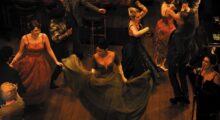
Tessa Thompson has a predilection for playing fiercely ambitious women. Against all odds, her characters stand firmly in their politics, like Sam in Justin Simien’s Dear White People (2014). Other times, they persevere despite cycles of poverty and nefarious circumstances, like Ollie in Nia DaCosta’s directorial debut, Little Woods (2018). These are women who tend to get what they want. But in DaCosta’s latest film, Hedda (2025), Thompson reveals the more sinister faces of human desire. The period film, which reimagines Henrik Ibsen’s play, Hedda Gabler (1891), is set in 1950s England and follows newlywed Hedda Tesman (Thompson), the mixed-race […]
-
Subterranean Histories: Laura Poitras on “Cover-Up”
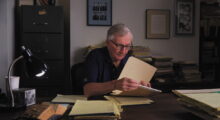
When we meet Seymour Hersh at his Washington office in Laura Poitras’s and Mark Obenhaus’s Cover-Up, the veteran journalist is framed by papers—documents piled on his desk, notebooks stacked against the wall, binders stuffed into bookcases. The man who began his career in 1959, broke stories about the My Lai massacre in Vietnam and prison torture in Abu Ghraib and penned provocative counter-histories about the killing of Bin Laden and the 2022 bombing of the Nord Stream pipeline is very much still at work. (Now on Substack, he’s recently been writing about the genocide in Gaza, Trump administration plans to […]
-
Source File: Mark Obenhaus on “Cover-Up”
Mark Obenhaus has had an extensive career in television documentary, having worked with ABC News as well as on the PBS series Frontline, Great Performances and The American Experience. His subjects have ranged from the Kennedy assassination to UFOs to Robert Wilson’s groundbreaking opera, Einstein on the Beach, and he has won five national Emmy awards, two for the Frontline series “Abortion Clinic” and “Living Below the Line.” He worked with Seymour Hersh on projects including the Frontline documentary Buying the Bomb and brought his long relationship with Sy and understanding of the reporter’s working methods and very understandable sensitivities […]
-
So You Want To Rule the Indie Film World (Redux)
In Filmmaker’s fall 1995 edition, producer Ted Hope’s two-part “Indie Film is Dead/Long Live Indie Film” offered a blunt critique of the independent film business coupled with a more optimistic call for a better future. (The former contained lines like, “Back-end is bullshit,” and “the IFPs and Sundance are the lone beacons, but even these not-for-profit groups are reliant on corporate dollars from the distributors for survival”; the latter, “Form an independent producers association.”) Running with a rejoinder from his Good Machine business partner James Schamus (“‘Develop a specialized film database?’ We already have one—it’s called gossip”), it was an extraordinary dialogue […]
-
On Eisenstein, Godard and Welles: Michael Almereyda & Radu Jude in Conversation
This past summer I was privileged to attend the Oxbelly Retreat in Costa Navarino, Greece, and to sit in on an intimate discussion between directors Michael Almereyda (Hamlet, Experimenter, Tesla), and Radu Jude (Do Not Expect Too Much from the End of the World, Kontinental ’25, Dracula). While heading Oxbelly’s screenwriting labs this year, Jude interviewed Almereyda about his influences, which Almereyda distilled to a set of paintings and photographs. In their conversation, a mutual love of the work of Sergei Eisenstein, Orson Welles and Jean-Luc Godard was expressed, and I was eager to read them expand on these passions […]
-
Shooting the 25 New Faces
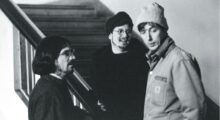
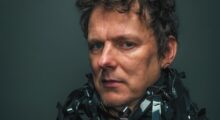
For a stretch from the aughts into the 2010s, Richard Koek was our 25 New Faces photographer. He’d meet our young selections in their homes, in restaurants and on the street, always returning with creative, alive images. He also shot several stunning covers for us, including the Safdie Brothers for Uncut Gems and Barry Jenkins, Wyatt Cenac and Tracey Heggins for Medicine for Melancholy. Here, he remembers his early process and two specific shoots: Michel Gondry and Lena Dunham. — Scott Macaulay Filmmaker asked me for several years to photograph emerging directors for its 25 New Faces section. As a […]
-
Independent Film’s Next Chapter
From observing the need to budget minimum wage when making a microbudget film to decrying the influence of television on cinema culture, producer and Emerson College associate professor Mike Ryan has long expressed a blunt, radical truth-telling in the pages of Filmmaker. Here, he asserts that the economic model that drove much independent production in the 1990s—creatively imagined features enabled by equity financing that was itself predicated on the existence of a competitive acquisitions market—is gone, but that this development is not actually one to lament. For those who transgress, the future is yours. The Hollywood-dependent system of so-called indie […]
-
Historicizing the Independent Awards Race: Manohla Dargis Speaks with Scott Macaulay
A garish panel from an R. Crumb cartoon was the cover of Filmmaker’s spring 1995 edition. Inside were interviews with Hal Hartley, David Salle, Lourdes Portillo and Gregory Nava; a David Leitner article on new trends in film lighting; a survey of new independent distributors; and Mikki Halpin on how the internet could help independent filmmakers. Finally, there was “The Vision Thing,” Manohla Dargis’s take on the Spirit Awards, the fundraiser of our co-publisher at the time, the IFP/West (now Film Independent). It was a pivotal year for the Spirits: they had previously announced that for the first time films […]
-
The Screen in the Sky: Drone Shows as Cinema
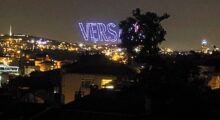
After I put my kid to sleep, I found myself standing by the window, looking out over the valley of apartment buildings. The house went quiet; the city softened into an arrangement of distant lights. As I stared into the sky, a bright purple word snapped into view over the horizon. At first, I thought there was something wrong with my eyes. Then, the letters sharpened: “VERSACE,” spelled out by hundreds of synchronized drones floating above Istanbul. I had never seen an advertisement suspended in the sky before. Billboards, phone screens—the daily flood of images is, today, expected visual noise. […]