Back to selection
On Eisenstein, Godard and Welles: Michael Almereyda & Radu Jude in Conversation
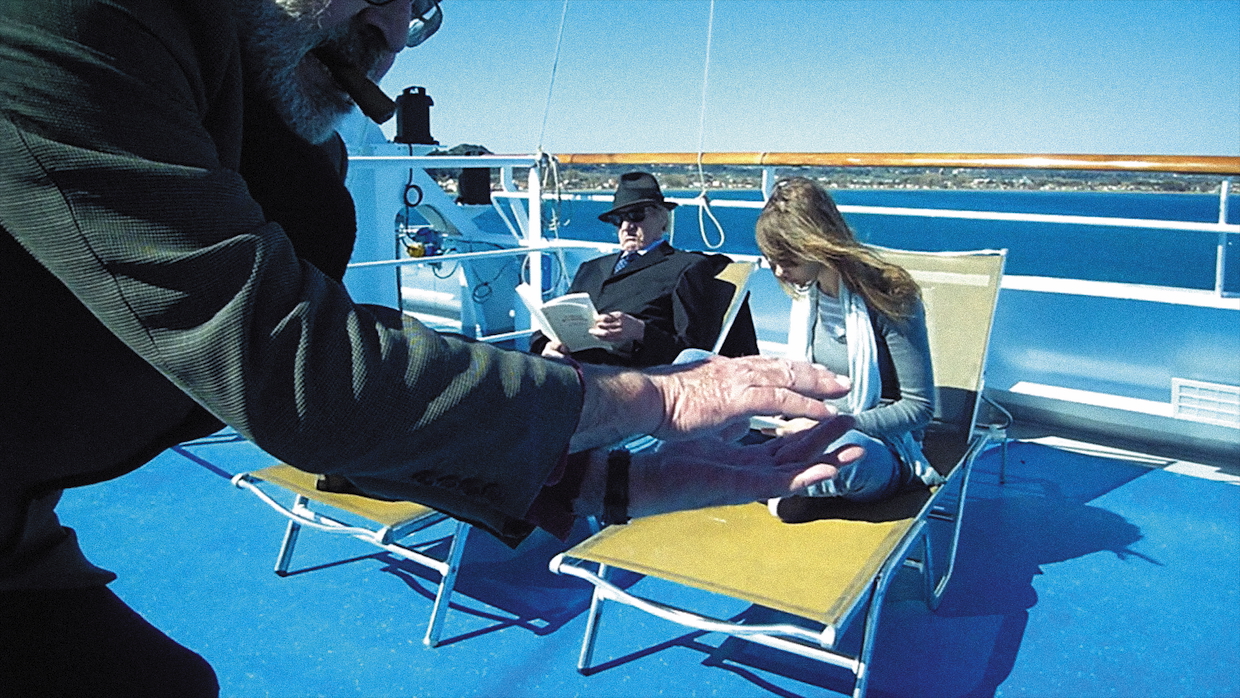 Jean Luc-Godard on the set of Film Socialisme as seen in Film Catastrophe
 This past summer I was privileged to attend the Oxbelly Retreat in Costa Navarino, Greece, and to sit in on an intimate discussion between directors Michael Almereyda (Hamlet, Experimenter, Tesla), and Radu Jude (Do Not Expect Too Much from the End of the World, Kontinental ’25, Dracula). While heading Oxbelly’s screenwriting labs this year, Jude interviewed Almereyda about his influences, which Almereyda distilled to a set of paintings and photographs. In their conversation, a mutual love of the work of Sergei Eisenstein, Orson Welles and Jean-Luc Godard was expressed, and I was eager to read them expand on these passions in the following epistolary exchange. — Scott Macaulay
Almereyda: Eisenstein, Welles and Godard are figures of such monumental achievement that I’m sure we’re not alone in claiming them as primary influences, but I felt a jolt of camaraderie when you named this specific trio, citing not only their films but their writing and interviews. So, I thought it might be worth talking more specifically about how these three conspicuous masters have influenced you, and what significance they continue to have for you.
Jude: Dear Michael, it is not an easy idea to pin down because I have already 48 years (you a bit more), and these influences change their meaning or their importance over time, and they also sometimes disappear completely. For instance, I properly discovered Orson Welles in May 1995 (probably it was an anniversary) [Welles’s 80th birthday], skipping classes and going to our Cinematheque in Bucharest, which, despite its horrible poverty, had very good programming (thanks to two people I want to name, despite the fact that no one would know them there: the filmmaker Savel Știopul and the film historian Mihai Tolu). What I liked back then was the spectacular side of Welles’s movies—the depth of field, the spectacular camera movements, the way he shot The Trial, etc. I also remember being moved to tears by his Ambersons. Anyway, if I think now about Welles, I care less about the spectacular side and what pops up in me is his originality, his bravery, a certain carelessness about his career but a powerful desire to experiment, to try out things, to innovate, to adapt to circumstances. These are, for me at this moment, his greatest lessons. How he invented the Turkish bath in Othello because he didn’t have the costumes ready and the only solution was to have so many actors naked in a scene. I love him now more for these things than for his mastery, as I am more interested in Eisenstein’s ideas about cinema expressed in his many texts than in his amazing films.
As for Godard, he is someone that gives me courage, no idea why. When I feel blocked with a project, it is enough to watch again any Godard film, and at the end I feel less blocked, less lonely and less scared.
But what about you? And why do we need these influences? I feel a bit ashamed, I have the feeling the great filmmakers function without needing anything, save for what they consume during their training period.
Almereyda: There’s hardly any cause to feel shame when learning from and leaning on these precedents, because they did their fair share of learning and leaning.
I fell under their spell when I was first dreaming about moviemaking, a teenage misfit newly transplanted from Kansas to Orange County, California. As a reclusive, over-serious, film-addicted adolescent, I was so enamored of Welles that I’d lie awake at night listening to audio cassettes of The Shadow and Donovan’s Brain, and I pretended to comprehend Eisenstein’s Film Sense (an excellent title) after admiring photos of the cloudy-haired director holding a strip of celluloid up to his eyes in a moment of visionary reckoning. There’s a fairly similar mass-circulated photo of Godard, whose movies, methods and interviews shook me up a few years later. It may be worth noting that one thing these rule-breaking polymaths had in common was a talent for self-promotion.
While the text for Film Sense may have been too dense for me (and can feel unyielding even now), Eisenstein presented script excerpts and storyboards and reproduced a Dürer woodcut and a painting by El Greco, so even on first contact the book brought home the crucial idea that film is a living language, linked to other traditions while excitingly open to experiment. Moreover, the experimentation can be passionately personal, as proven by Eisenstein’s eagerness to list his own influences (Daumier’s drawings above all). It’s not hard to track Welles and Godard inheriting and expanding Eisenstein’s lessons, aggressively playing with images and sounds in every movie they made. As versatile as they were, you can reliably identify a film by Eisenstein, Welles or Godard within 30 seconds, no matter what patch or period you might happen to land on.
It’s also fascinating, to me, to consider how these three moved within very different career trajectories beyond any smooth or easy path that early international fame may have afforded them. They each made brave and unexpected leaps (and fell into unforeseeable and inescapable holes), and yes, a large part of their legacies involves the ways they stretch or efface definitions of success and failure.
Eisenstein had the most privilege, I suppose—the biggest budgets, being initially funded by the Soviet state, then seriously courted by Hollywood—but he was also, throughout his career, on the shortest and tightest leash, and probably the most tormented by the distance between his planned and imagined projects and their butchered or abandoned corpses and afterbirths. We both love Jay Leyda’s Eisenstein at Work, the 1982 book showing exactly how energized and irrepressible Eisenstein’s thinking could be, and how skillfully he could draw (even better than Welles). If he hadn’t died at 50, you could imagine Eisenstein conjuring some amalgam of Italian Neorealism and the French New Wave, prefiguring Pedro Costa (gleaming baroque imagery contained within a program of absolute “authenticity”). Aren’t the outtakes from Eisenstein’s unfinished Mexican movie pointing in these directions?
I’m glad to know you’re sympathetic to Welles’s later career. We can take courage from how he became a thoroughly independent filmmaker, throwing costumes on himself and Oja Kodar, his formidable girlfriend, and shooting scenes piecemeal in his Hollywood backyard. (When I met Ms. Kodar 10 years ago at a Welles centennial at the University of Michigan, she was unpretentious and teasing, and casually called me “Lord Byron”—because, I think, of how my hair had been hit by the Ann Arbor wind.)
And even though Welles could seem to be isolated and scornful of contemporary filmmakers, you see evidence of brotherhood in his affection for Cocteau, Renoir and John Huston, and there’s the wonderful self-mocking collaboration with Pasolini (La Ricotta, 1963), plus the complicated alliance with Bogdanovich, which, anyone can see, was not simply transactional. More to the point, we find Welles late in the game becoming a pioneer of the essay film, discovering a new vocabulary with F for Fake, a personal work collaged from footage shot by other people. (There’s also the unprecedented nine-minute trailer for F for Fake!)
I’ve offered less about Godard because he’s probably the deepest influence for me, the most provocative precursor, while also being, from the available evidence, the most aloof and disagreeable character, at least as he aged. His films and writings show us how open-hearted, rechargeable and hopeful the medium can be, a form that, in his hands, flirts with and frustrates narrative, questions and rescues history, and stirs emotion beyond conventional empathy.
Jude: It took me a while to offer an answer—actually not sure I can add anything to what you’ve said. You mention that all three had a talent for self-promotion, something I don’t care about that much, since it is not something I could ever have, I guess, but what about another talent, to always be able to adapt? I mentioned Welles before, but Eisenstein was able to somehow land on his feet and avoid the Gulag after Bezhin Meadow and staging Wagner in 1940, etc. And I always saw that in his texts he was pretty obviously not caring much about the mandatory references. He quotes Marx, Lenin, etc. just to fulfill the obligation, then he moves on to what he really appreciated: El Greco, Balzac, Daumier, da Vinci, etc.
As for Godard, I think he was always conceiving his films in a way to transform the limitations into advantages, making virtues out of necessity—like making Made in USA simultaneously with Two or Three Things… because the producer needed to start a project, or making A Married Woman extremely fast out of some kind of a bet or doing Detective in order to finance Hail Mary. All Godard films are not only a lesson in cinema but also one in adaptability and getting stronger because of limitations. I consider some of your films in this line. You mentioned using the cheap Pixelvision camera as a tool of survival, not as a gimmick. And you fooled Weinstein to let you do Shakespeare’s Hamlet. (I wouldn’t have accepted this project if I were him). And when you couldn’t do films with lots of money, you made great cheap documentaries like the Eggleston one or short videos.
I offer you also an image, with Godard slating himself the shots in Film Socialisme without a slate, with his hands only. Probably you saw his nephew’s film made from the outtakes of the film? It is titled Film Catastrophe, and it is amazing for this—to see Godard working with fewer resources than any film student: [filmcatastrophe.com/film-1]
Almereyda: Thank you for alerting me to the existence of Film Catastrophe! Yes, yikes—it’s wild and more than a little touching to see the master at work, 80 years old, with wonderfully reduced equipment and a two-person crew, while often wielding a cigar as thick as a thumb. Who needs a slate or a script supervisor, really? I’m fascinated by how he seems to be arranging things more than he’s discovering things, how he talks his actors through multiple takes, fussing with the placement of people and objects, the exact wording and pacing of dialogue. Patient, controlling and only occasionally amused. But I take your point: it’s worth underlining that he continued making original, haunting and even heart-stopping films in the 21st century, embracing digital video (In Praise of Love, 2001), experimenting beautifully with 3D (Goodbye to Language, 2014), blurring the boundaries of fiction and essay films. He was weary but ardent, lyrical and didactic, convinced of his moral rectitude while remaining unabashedly playful.
I’m a bit embarrassed when you invoke my own wayward filmography. Mildly shocking to think my attempted jailbreaks may have been meaningful to a person making such liberated and liberating films in far-off Romania. I salute you for the sense of freedom in your work, the mix of genres, styles and tones, the confident impudence. Also, the physicality of your films balancing the evident brain power with your sure grip on history, texts and traditions. Also, not incidentally, I’m impressed by the explicit ways you show sex and politics to be entangled human preoccupations—another point of contact with Godard, yes? Though in your films that relationship seems looser, sweatier and funnier that JLG managed to make it.
Jude: Well, as I have just finished a 20-minute montage film commissioned by Torino Cinema Museum and having used as materials only their collection of 35mm porn movie trailers (it is called Trailer for Dante’s Paradiso), it seems as if I am somehow interested in this theme. I am actually not, not more than anybody else, I mean, and you mention the funny aspect in the representation of sexuality in my films—I am happy you mention it because I am inclined to see the ridiculous side of life. And Kundera mentions the comic side of sexuality in an essay, so that is all about, I guess. Maybe also the fact that in Romania anything related to sex and nudity was completely repressed during the long Communist dictatorship, so that after the 1989 Revolution you find a population mostly having an abnormal relation to the representation of both: either an extreme prudishness or a dirty pornographic perspective. I am not sure I am more mature than most of my countrymen, and I guess, as I always have been shy and somehow dumb, and as I don’t want to become a dirty old man, I prefer to see mainly the comic side of it all. But it feels already too much like a confession at a therapist, and I don’t have the time and energy for therapy, nor desire, never had it; I want to live and die with all the sadness, loneliness and neuroses, like the leopard with the spots on its fur, as the proverb goes.
Almereyda: This exchange has led me back to a particularly battered paperback book chronicling Godard’s first decade of moviemaking—actually, his astonishing first nine years—stacking critical essays alongside Godard’s film treatments, interviews, journal entries. Do you know it?
Godard is eternally reminding us that cinema isn’t a self-contained pursuit but, at its best, draws from and feeds into a wider world. Allow me to flag a few quotes:
I make my films not only when filming, but as I read, eat, dream, even as I talk.
Cinema is interesting because it seizes life and the mortal aspect of life.
I buy certain papers solely to read the advertisements.
There is documentary realism and there is theater, but ultimately, at the highest level, they are one and the same. What I mean is that through documentary realism one arrives at the structure of theater. And through theatrical imagination and fiction one arrives at the reality of life. To confirm this, take a look at the great directors, how they pass by turn from reality to fiction and back again.
I also hit a passage that squarely addresses one of your earlier remarks, incidentally, glancing off the two other faces that make up the particular pyramid under discussion:
Influences are fragmentary and momentary. One is not influenced by Orson Welles, but by a certain element or idea in Welles that one wants to redo. And nobody has ever been influenced by Eisenstein; nobody has ever made a film like him.
Jude: I know the book, of course, and let me finish with a reading recommendation: Michael Witt wrote a book about Godard’s unmade films; it is amazing. It is titled Jean-Luc Godard’s Unmade and Abandoned Projects, and it should be paired with Eisenstein at Work and Orson Welles au travail.