Back to selection
Transformer Model: AI in Film Schools
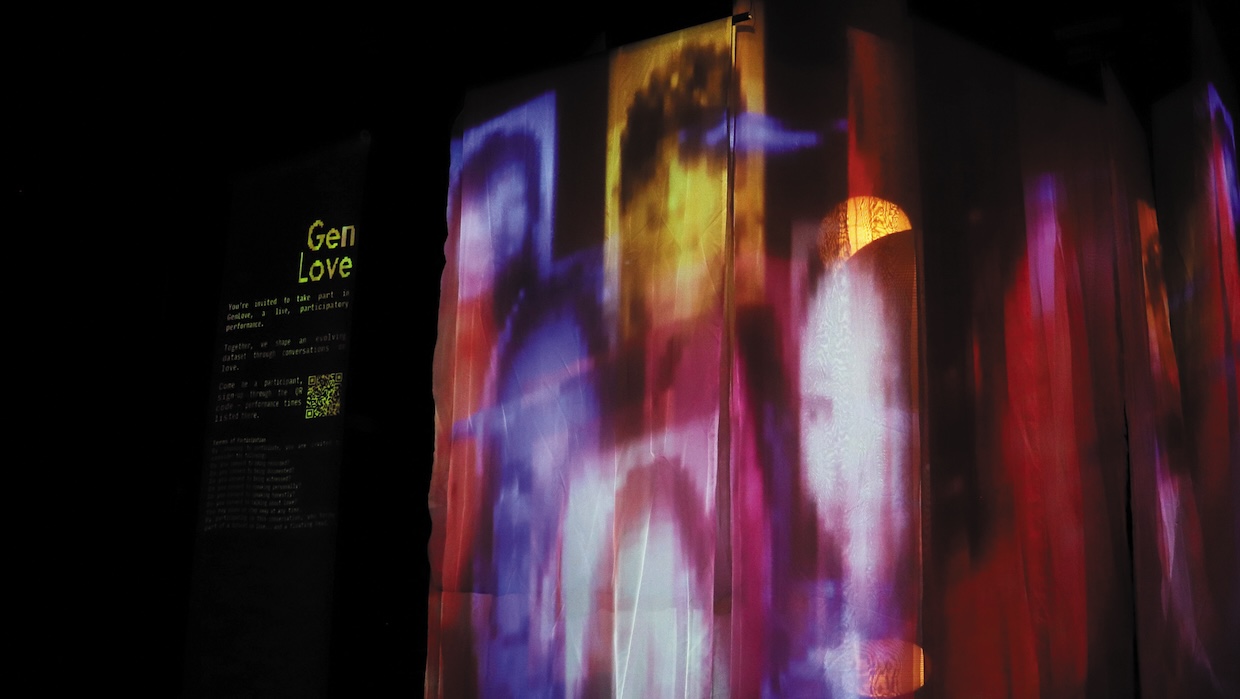 Katie Luo's Gen Love
 “You can love it, you can hate it, you just can’t ignore it,” says artist and UCLA lecturer Bill Barminski about the use of Artificial Intelligence (AI) in filmmaking. Barminski’s sentiment is echoed by other film school faculty, staff and students, who all recognize this divisive technology is here to stay and that it would be foolish for students not to engage with—or at least understand—it.
AI is a wide-reaching term, encompassing text-based services like ChatGPT and DeepSeek, which many film students say they use for ideation or to help with loglines, script notes, grant writing and pitch-deck creation. AI can also generate onscreen images and videos through generative AI (GenAI) programs like Midjourney, Sora and Veo 3, which are controversial due to the legal and ethical issues around these models’ presumed scraping of copyrighted material as training data. And it includes pre- and post-production tools, which many don’t even think of as AI because Adobe Creative Cloud and DaVinci Resolve have incorporated these for years.
USC School of Cinematic Arts MFA student Rita Pereyra used Adobe Firefly to create storyboards for her upcoming thesis project. “Even if I had money to spare to hire storyboard artists, AI did it so much faster,” she explains. “I had my entire storyboard—[more than] 100 little blocks—in less than a day.” It’s hard to ignore AI tools’ combination of speed, affordability and ease of use—a paradoxical appeal for students who enter an industry facing potential job loss due to the technology.
The rapid acceleration of AI across all these avenues has forced film institutions, often cautious about chasing trends, to begin either codifying best practices and ethical standards related to emerging technologies or allowing their esteemed staff—often working artists and filmmakers themselves—to take the lead. Conversations abound, both privately among faculty and staff and in public forums such as CalArts’s UNBOUND AI symposium. At the second annual UNBOUND symposium this past April, for example, animator, visual artist and CalArts trustee Lyndon Barrois discussed his work as a tester for GenAI program Sora.
Three years ago, Barminski introduced students in his post-production class to AI tools, mostly so they’d be aware of them, but the practical results were subpar. “Here’s one of these [so-called] magic tools that’s supposed to do the rotoscoping for you,” he told them. “Don’t bother with this, it’s not going to get you very far.” Today, he presents this technology, which now includes GenAI tools, differently. “You guys have to pay attention to this stuff because it’s going to change your creative work,” he tells his students. “It’s going to affect your creativity, your job, your employment.” If filmmakers can use AI quickly and cheaply to perform tedious or specialized VFX work themselves—similar to how Pereyra quickly created her own storyboards—workers in key segments of the film industry stand in jeopardy of becoming obsolete. While we might not be at that point just yet, simply due to the output and performance quality of many of these tools being below Hollywood film standards, that’s only “for now,” Barminski says. “That’s going to change. The pace of these tools’ improvement is really stunning to me.”
Students’ perspective on AI is decidedly split. Many utilize it in their everyday work without too much reflection, while others have a knee-jerk negative reaction at the mere invocation of the two letters. New CalArts Dean of the School of Film/Video Ranu Mukherjee acknowledges her students’ justifiable apprehension: “Students are thinking about industry and job loss, particularly in the animation sector.” She also pinpoints their deep concern with the technology’s environmental impact because GenAI platforms notoriously eat up a lot of computing power. This past April, CalArts announced a partnership with CHANEL Culture Fund to build the CHANEL Center for Artists and Technology with two areas of focus: AI and machine learning, and digital imaging. In response, CalArts character animation undergrad Niq Ducote organized a petition in opposition to the center, highlighting the ethical and environmental concerns with the use of AI. At press time, the petition had 486 signatures from CalArts students, alumni, faculty and staff.
Acknowledging the debate, Mukherjee clarifies that the forthcoming “CHANEL Center is a research center. So, it’s primarily about giving artists tools to consider what they can do with the new technologies rather than job training for specific roles. That’s a pretty important difference. It’s about having the students and researchers work together to try to define what machine learning can do.” Film schools at UCLA and USC are couched within research universities, granting them a potential advantage with how to engage with emerging technologies. USC announced its own USC Center for Generative AI and Society in 2023, including a class on AI for media and storytelling.
Mukherjee sees implementing AI into production workflows as a natural extension of how CalArts students have been mixing technology—analog and digital—for decades. “Somebody might shoot 16mm film that then goes into a VR application, for example,” she says. “We focus on the fundamental principles of being a filmmaker and an artist at CalArts. Those elements are the foundation. You still need to know what a frame is, how a film moves in time, how a narrative unfolds or doesn’t. Elements that are fundamental to filmmaking aren’t changing. It’s the tools that are changing.”
When preparing to teach a class on AI a few years ago, CalArts special faculty member in experimental animation Douglas Goodwin looked at a variety of programs—including DALL-E, Midjourney, Runway ML and Automatic1111—and even hand coding. He ultimately settled on ComfyUI, a visual node-based interface to Python code with a highly customizable nature. “Avoiding ethical generative AI dilemmas is up to the user, but at least ComfyUI gives you a choice of which models to use,” Goodwin explains. “It makes the whole process more visible and accessible than other products.” While imperfect, ComfyUI allows users the ability to consciously avoid sourcing copyrighted material and engaging in the “art theft” Ducote highlights as central to organized opposition to GenAI at CalArts.
Goodwin’s read on his animation students’ apprehension to AI differs slightly from his colleagues’. “They don’t want to disrupt their process. They spent years putting it together and feel pretty confident after getting into CalArts that what they’re doing is good.” Having these students pivot from difficult animation programs and processes they worked hard to master toward AI workflows is a tall order. “They’re more conservative than I expected in terms of new tools,” he says. But Goodwin has witnessed this reticence lessen with each semester he has taught the class. “When I first taught the AI for Animators class at CalArts, I’d say two out of 16 students found a use for AI,” he says. “The second time I taught it, about a third of them said that they would use it in their work.”
CalArts BFA experimental animation student Angus Oakes took Goodwin’s class out of curiosity and says he enjoyed that it “wasn’t just a class using AI, but it focused around understanding what AI is, where it came from and how it works.” Even though he didn’t end up using AI in his animated thesis project, Oakes sees his fellow students’ push against the technology as “fear of the unknown and what could be.” For Oakes, AI is “nothing more than a tool to help in your own workflow, in your process of creating your own art.”
This “nothing more than a tool” sentiment is shared among many film students and professors across a variety of disciplines. “How do we use AI for the busy work that’s tedious that none of us wants to do and keep the craft of filmmaking?” asks Holly Willis, USC chair of the Media Arts + Practice program and Filmmaker columnist.
In Goodwin’s mind, a pesky element of many GenAI tools is how they are designed to produce finished products. The product designers and engineers do “not think like artists at all,” Goodwin says. Alternately, ComfyUI allows users to pinpoint each stage of the generative process and make adjustments in a more deliberate manner. Other platforms rely on more of a trial-and-error approach with what comes out the other end: you feed it a prompt, take notes on the generated result and try again with adjustments.
Jeff Burke, associate dean for research and technology at UCLA’s School of Theater, Film and Television (TFT), also wishes artists and instructors had a stronger hand in the development of these tools. “The AI tools that everyone knows come from companies whose core business is not in the arts,” Burke says. “What if you try to give artists and folks in the creative industries the opportunity to either originate tools or shape them more? There are industry players doing that, but it’s also a place where universities can contribute and get other voices into the technology development process.”
UCLA TFT moves more directly into GenAI with its new Amazon generative AI fellowship. Six student thesis projects across a range of genres, all committed to using the technology in fresh ways, recently wrapped a six-month development phase and will move into production shortly.
Goodwin recently aided CalArts MFA graduate and Filmmaker 25 New Face of Independent Film Rajee Samarasinghe in the limited use of generative AI for his Rotterdam-premiering hybrid-documentary Your Touch Makes Others Invisible. Samarasinghe enlisted Goodwin, whom he knew from CalArts, to assist in the implementation of two deepfakes, in which two famous Sri Lankan politicians’ faces are swapped onto actors. Samarasinghe describes it as “a subtle use of AI, almost an Easter egg. It’s meant to be a quiet visual clue, something that Sri Lankan audiences might pick up on even if it goes unnoticed by other audiences.” Goodwin coded the face-swapping technology himself, and while he could’ve used ComfyUI, what he developed skips that program’s interface for a more direct and catered approach. “We wish to acknowledge the use of generative AI technology in this documentary, applied in a few select shots,” the audience is alerted by the film’s opening title card.
Further leaning into this intersection of coding with artmaking, CalArts is introducing a Creative Computing degree beginning in fall 2026. This involves two years of creative coding, followed by a shift toward specializations. “For the film school, we’re thinking about things like immersive media and gaming and virtual production,” Mukherjee says.
Katie Luo is a USC undergraduate in the Media Arts + Practice program. The nature of Luo’s technology-centered major means that among her fellow students, “everyone’s mostly open to AI,” she says. The department encourages a range of expressions that goes beyond traditional cinema. Luo’s installation “Gen Love” takes recorded conversations she had with her friends over tea on the nature of love and transforms them into a live visual dataset that an AI uses to carry out an ongoing dialogue on the nature of love. Described by Luo as a “participatory performance installation,” the piece deals with “the subjectivity and contradictions of what it means to be human.” Initially, she worked to create her own enclosed machine-learning server, but her computer wasn’t able to handle all of the data locally, and responses to prompts were taking minutes at a time to generate. She ditched this experiment, opting to use a traditional text-based AI generative platform, then used TouchDesigner to create “projections of the people’s faces who did the performance to make a visual form of the data set.” More generally, Luo is a fan of bouncing ideas off text-based AI platforms and sees many of her fellow students doing the same in their own schoolwork: “AI is so integrated into work habits overall that it’s pretty common use now, especially for the ideating process.”
Many film students take advantage of opportunities to play around with new tools even if they don’t directly correspond to their artistic practice. Pereyra’s USC thesis is part of a special program that requires 50 percent of production to shoot on USC’s volume stage. As a self-described “grounded, cinema verité naturalist,” shooting on a volume isn’t an obvious fit for Pereyra, but learning the unique production workflow that comes with virtual production intrigued her. “Once I’m out in the industry, I can say, ‘Yes, I know how to shoot on an LED wall.’ It’s definitely one of those things that you have to learn hands-on by doing it,” she explains. A variety of AI tools will also be utilized in her production, some involving the volume stage, like an Adobe Photoshop tool that helps extend the set with AI. USC’s volume stage isn’t large, so this tool is a must for many shots.
Within USC’s School of Cinematic Arts, Willis is pushing for the school to more holistically address how different disciplines and technologies cross pollinate within a filmmaker’s artistic practice today. The programs within USC’s film school have gotten together for conversations surrounding “emerging workflows at the intersection of cinema and game design.” Citing “workflows that rely more on world building and virtual production,” Willis asks, “How do you take cinematic elements into gaming, and how do you take certain elements from gaming into the cinematic?” Film schools like USC and others are increasingly pushing their students to experiment and rethink what cinema can and should be.
UCLA is also dipping its toes into the virtual production landscape, partnering with 4Wall Entertainment to install a temporary volume stage on campus this spring. A second, larger stage will be installed this summer. Burke explains, “It’s a big capital investment to put a volume stage of any scale in.” By focusing on rentals for now, UCLA can expose students to the technology in a hands-on way, bringing them “the latest equipment” as they pinpoint exactly what the school “wants to do pedagogically” with this new technology, Burke explains. Additionally, on-set virtual production will be required for all UCLA MFA cinematography students.
Mirroring the massive Hollywood productions its home state’s tax incentive attracts, Savannah College of Art and Design (SCAD) wasted little time betting on virtual production, opening a volume stage on its Savannah campus back in 2021. A large LED wall for its Atlanta campus followed in 2022. “We were the first university in the world to have two LED volumes, and these stages, along with our state-of-the-art Hollywood backlot, are our classrooms,” says Andra Reeve-Rabb, dean at SCAD’s School of Film and Acting. “Access to these innovative resources gives SCAD students an invaluable advantage in a highly competitive industry.”