Back to selection
Steven Soderbergh on Making The Christophers With Michaela Coel and Ian McKellen
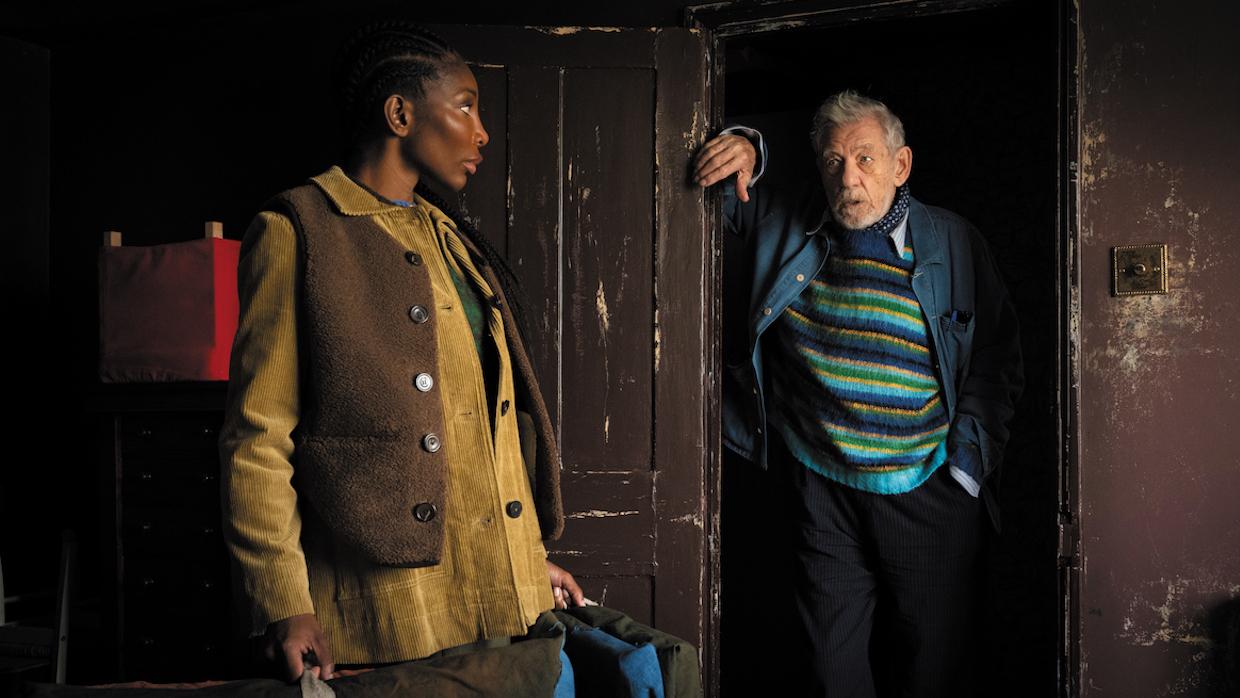 The Christophers
 Twisty as a Hitchcock movie but not a thriller, Steven Soderbergh’s The Christophers is a two-hander for two great actors. Michaela Coel plays Lori Butler, a serious painter with a side gig as an art forger. Ian McKellen plays Julian Sklar, an art world star in the 1960s and ’70s who hasn’t made any work of note in decades. Julian’s children, who hate him, concoct a scheme in which Lori is smuggled into Julian’s dilapidated five-story house as a temporary assistant. She is tasked with finding “The Christophers,” a series of portraits that Julian began in his prime but never finished. If Lori can complete them, unbeknownst to Julian, the kids will sell them after he dies and make a fortune. The Christophers is a heady dark comedy about value and values in the art world and beyond. The first time I saw it, I thought it was a trifle, but it stayed with me, so I saw it again. It is one of Soderbergh’s best and most personal films about art, relationships, and the instability of everything we believe we know.
Filmmaker: I really like this movie. Michaela Coel was great in her own series I May Destroy You. But here, she’s working with Ed Solomon’s script and your direction, and she’s just as exciting. Too much has already been made of how she and Ian McKellen are such different kinds of actors, but they aren’t. They are playing characters who, temperamentally, are polar opposites, but as actors their process is much the same. This film is so different from your last, Black Bag, where the actors were so withholding. These two actors just spill from the screen, grab you, and invite you in.
Soderbergh: That’s where Ed Solomon really shines. My initial pitch to him was tilting much more in the Patricia Highsmith area. It was darker, borderline unpleasant. The young woman’s character was a lot less open. I imagined her as Tom Ripley. Ed opened it up, made it warmer and more emotional, which it needed. He did that on his own. That’s just who Ed is. And that’s why it’s good he wrote it and not me or someone else. And then, he worked very, very closely with Ian and Michaela, going through the script line by line to make sure everything made sense to them and they felt it was organic. It was not a long shoot, and there was a little bit of movie magic in terms of the exterior of Julian’s house was not where the interior was. But we tried to shoot in sequence, and there’s the benefit of me editing at night as we shoot. Ed and I were doing a fair amount of recalibrating as we were shooting. There was one key scene, where they meet for the first time, that I shot twice. I shot it on a Friday, and looked at it over the weekend. I called everybody and said, we’re shooting this again. The energy and the way I was staging it wasn’t quite right. We did that fairly regularly because at the end of 18 days, Ian and Michaela were going off to do other things and would be unavailable for a long time. As it turned out, I still had to fly Michaela back from Ghana, where she was prepping her new show, to do a couple of pieces. She had to get her hair braided again, which takes hours. If people have seen her show, they aren’t sure what to expect from her in person. She’s really lovely, she likes to laugh, and she just radiates positive energy. I just love the idea of seeing her and Ian in a frame together.
Filmmaker: Since you brought up staging, I thought this was the best handheld camerawork you’ve ever done. It wasn’t showy or conceptual; it was truly invisible.
Soderbergh: And I wanted the conceit to be invisible, too. Which is that once you cross the threshold of Julian’s door, you are handheld. And whenever you are outside the threshold of the door or in other places, we’re in studio mode. There are two reasons for doing that. It expresses the instability she feels emotionally when she’s there, and it’s also practical. It was easier to move around that cluttered space without a dolly. But when she goes back near the end, we’re in studio mode inside the house, and I wanted you to be aware, without knowing why at first, that something has changed. I realized at one point, just before we started shooting, that there’s a 33-page sequence in this movie that’s all people talking in a row.
Filmmaker: Like in a stage play. And that’s why the camera movement is so important. Because it puts you inside their POVs and their relationship, which you never have when you watch a play. But the dialogue is so good. It’s one of the rare films where painters talk the way actual painters do. I remember that about 13 years ago, you said you were quitting filmmaking and you were going to paint.
Soderbergh: It ended up being about three months before that plan changed. My feeling, based on whatever abilities I had and the lessons that I was taking with Walton Ford, was that it would take five years of continuous work to result, by my standards, in something showable. I was up for that. I liked the solitary nature of it. And I had an idea of what I wanted to do. Faces interest me. When I start working on a job, the first thing I see is faces with a certain emotion on them. So, compositionally, I wanted to recreate film frames in paintings. I never knew how that would work out because The Knick showed up. And on those occasions when something is put in front of you and you literally can’t bear the idea of somebody else doing it, you have to follow that. And once I got back on set, I realized that I like this job. I just really hate the business. And I needed to learn how to separate those two things better.
Filmmaker: You said that for The Christophers, Ed worked a lot with the actors on the script. But when you are shooting, do you give directions to the actors?
Soderbergh: I keep it really minimal. My notes are mostly physical. When an actor feels like their body is doing the thing that their character’s body would do, then they are in the right space. I don’t want to get in their heads. I don’t want to break the spell by talking shit. But physical things help orient them. It could be as specific as “Don’t look up until that line.” Making sure that their physical orientation toward each other is both plausible and organic, and is an expression of what’s happening in the scene emotionally. You should be able to watch this with the sound off and understand the relationship and how it’s evolving. In staging, framing, and cutting patterns, I’m trying to make it as though it would work as a silent film, which is why I’m so focused on the physicality of the actors. When Michaela was about to leave us to work on her new show in Ghana, she said, “I’m so glad I did this. It was a reminder of how simple it can be. The fact that it was just you and the camera and not a lot of takes, that you can shrink it down to be something really intimate.” So, the last thing you’d want was to get in the way of these two actors. Their understanding of it all is so complete, to the point of knowing what lenses do what. And how to use the camera to get across what they want to get across.
Filmmaker: When you operate the camera, are you surprised by what you see through the viewfinder? Is it like seeing something for the first time, or are you just paying attention to the framing and the focus and the technical stuff?
In mainstream cinema, the pushing of boundaries that we saw for a couple of decades has disappeared.
Soderbergh: All of that. It is like seeing the movie for the first time. So, it’s always exciting. The trick is to make sure that the frame works. But the best part is the surprise, the thing you couldn’t have consciously conjured that somebody brings to it. It’s not that I’m the best operator on the planet, but I wouldn’t want to give up the intimacy of it. And the actors know they are seen. It’s different for them than a note that comes from somebody who’s 100 feet away, sitting at a monitor. Could I quantify the difference in the performance? No. But I just know they enjoy it as a process. When I’m that close to them, I can touch them sometimes, if I need to adjust them in a frame. I can whisper to them.
Filmmaker: Do you know that while he was making the great narrative films of the 1960s, Godard made his actors wear earphones? Raoul Coutard was shooting with that giant Mitchell camera, and as he rolled, Godard talked to the actors through those hidden phones. He fed them lines, asked them questions, told them where to move. When you look at those movies you realize they are listening to him and talking back to him.
Soderbergh: That’s wild. Immersive, I think is the word. For me, the benefits of all the new technology is just the ability to work more quickly with fewer people, and see something that very much approximates a final form quickly, so that you can make adjustments while you’re there. If I’d had the ability to do this with my first three films, they would be better. It goes back to the idea of a career and its connection to how the medium changes.
But if you want to make movies, I think it must be very hard to be starting now. Something that Ed and I talk about is the idea of a peak form in any medium and whether or not, at a certain point, reiterations are enough. I don’t know how you make a better movie than Sunset Boulevard. Was that peak form? Or peak for that era, the studios in the days of censorship? And then, after the ’70s were over, was that sort of it? When independent film showed up, and I was certainly part of that, I don’t think it was work that hadn’t been done before, somewhere. It’s just that after the ’80s, when the studios had taken back control, American audiences were hungry to see something that felt like it was made by an individual rather than a corporation.
In terms of form, people push it—David Lynch was always pushing shit. It’s mutating but not getting better. In mainstream cinema, the pushing of boundaries that we saw for a couple of decades has disappeared. And we’re sitting in a grammar that peaked a while ago. There are two reactions to that. You can quit or you can do something that this film is trying to do: distill things to their absolute essence and just focus on a story that specifically you haven’t told before. I hadn’t really gotten into telling a story about somebody who’s near the end of their life and is thinking about what they’ve left behind artistically, especially if they haven’t done anything, as is the case with Julian in this film, that anyone has rated highly in 25 years. What would that feel like?
Filmmaker: You can think about it in relation to an individual painter or filmmaker. Or how, in terms of the formal history of the mediums, they hit a wall around 1970. And perhaps, paradoxically, they are being revitalized by facing down the horror of AI. But maybe that’s too depressing to talk about.
Soderbergh: It’s worth talking about what that technology might be good at. I’ve been working with AI lately on the John Lennon and Yoko Ono documentary that we’re almost done with. AI has been helpful in creating thematically surreal images that occupy a dream space rather than a literal space. And that’s been really fun because you need a Ph.D. in literature to tell it what to do. But like every other piece of technology, it desperately requires very close human supervision.
Filmmaker: Which raises the larger problem of the war machine, something that John and Yoko tried to make people aware of.
It’s not that I’m the best operator on the planet, but I wouldn’t want to give up the intimacy of it. When I’m that close to them, I can touch them sometimes, if I need to adjust them in a frame. I can whisper to them.
Soderbergh: When we talked to Sean Lennon about the film, he said he was worried that young people have no idea what John stood for and he’s hopeful that our film will let them know what he did outside of making music. It was a wonderful, serendipitous thing that the three-hour audio recording that John and Yoko did for RKO Radio just a few hours before he was killed showed up as a possibility for a film. Clips from it were heard after he died, but not the entire thing.
I’m excited for people just to hear it because of how open they both are about art and love, and politics, and how relevant everything they say remains. The hardest part for me was editing it down to something that had a shape because I didn’t want to lose any of it. Ninety percent of the visuals are archival stills, and 10 minutes, spread out over the 90-minute film, are these little pockets of images we created whenever they start talking philosophically. When there’s no literal component to what they’re saying, then I create these images that are kind of a surreal version of what their words try to transmit.
Filmmaker: When will it be finished?
Soderbergh: May, I think. And in June, the box set of all the films I made that I own will be ready. I’ll sell them off my website. My White Album. They’re all individually stamped and signed. And I finished my book on directing, which will be released as an app at the end of April with the proceeds going to a cat charity in Britain. And I’m trying to get a movie made about the Spanish-American War.
Filmmaker: With ships and everything? For which you would use…
Soderbergh: A lot of AI. It’s my version of one of those. It’s a really good story, and nobody’s really done it. Every day that goes by it becomes more timely. I’ve just got to get it cast. I’ve got Wagner Moura. I need a few more people. I have two studios circling, but it’s all about how much I can do it for. But if I can get the right cast together, that will eventize it, and people will feel they have to see it now rather than waiting two months until it streams. It’s a weird time to be making movies.