Back to selection
Take Only What You Need: Kelly Reichardt Discusses The Mastermind with Yorgos Lanthimos
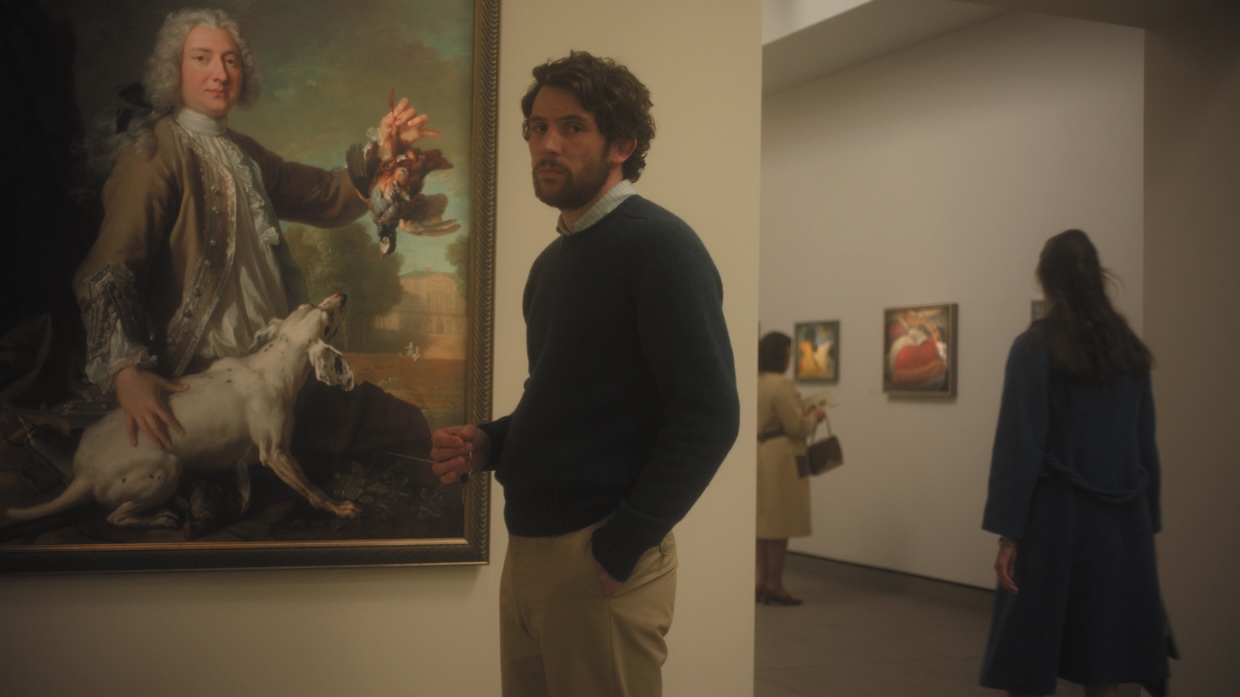 Josh O'Connor in The Mastermind
 In 1972, a thief and two accomplices stole two Gauguins, one Picasso and a Rembrandt from the Worcester Art Museum in Massachusetts. At the time, it was the largest art heist (and the first armed art heist) in American history; the thief, Florian Monday, would have entered the criminal pantheon had he not been swiftly captured after indiscreetly bragging about his crime. As she reveals in her conversation below with director Yorgos Lanthimos, Kelly Reichardt has kept an “art theft” file over the years, with an article on the 50th anniversary of the Worcester crime providing inspiration for her latest picture, The Mastermind. Josh O’Connor plays James Mooney, a would-be architect, petty thief and haphazard father whose memories of the work of an American artist introduced to him by a college professor triggers a desire to steal his work from a local museum. The crime isn’t solely about the money—the museum houses many more valuable works—but Mooney has an ineffable fascination with these works, a connection on a subconscious level, with their modesty speaking to his own self-image and, perhaps, ideas about the presence of the sublime in everyday life.
Writing the script for The Mastermind, Reichardt chose the purloined artist to be the American painter Arthur Dove, “almost like a placeholder,” she said in Cannes. “His paintings were too unknown in 1970, and they’re quite small.” But, she added, “I love them. Arthur Dove was an American landscape painter, maybe the first American modernist, but also [his paintings] were small in scale, fit our size museum, our size film, Mooney’s size ambition. And the colors ended up being very nice for our film.”
Writing about the painter in the Wall Street Journal in 1998, Francine Prose praised Dove, noting that “many of his artistic choices were dictated by the cost of materials,” but that his works contain “an immediacy that bypasses, subverts and outdistances language.” That description applies to Reichardt’s work, too. As she has done in pictures subverting the American Western (Meek’s Cutoff), artists’ process movie (Showing Up) and buddy picture (Old Joy), Reichardt again takes a genre—the heist movie—and strips it of familiar rhythms and programmatic elements to connect to something more resonant and reflective of American history. It’s clear from the picture’s start that Mooney is, ironically, no mastermind, and as his bumbling efforts to escape the police (yes, the film is also a comedy) compound, Reichardt sets Mooney in relief against the era’s social fabric, in which protests against Nixon’s war filled the streets. Mooney is neither hero nor anti-hero, yet the film leaves us asking, where’s the real crime?
O’Connor brings a dejected charisma to the role of Mooney, his increasing desperation downshifting perfectly into Reichardt’s offbeat rhythms. The excellent supporting cast includes Alana Haim, Hope Davis and Bill Camp, and returning with fine work are her regular DP and production designer, respectively, Chris Blauvelt and Tony Gasparro. We’re grateful to Lanthimos for talking with Reichardt just two weeks before the Venice premiere of his own new movie, Bugonia, a violently funny diagnostic for this conspiracy-addled era featuring superb performances by returning actors Emma Stone and Jesse Plemons. Bugonia is out this fall from Focus Features, as is The Mastermind, from MUBI. —Scott Macaulay
Reichardt: You got a haircut for the Zoom? Looking fresh.
Lanthimos: No. Actually, I shaved my head because Emma shaved her head for the film.
Reichardt: How’d you break that to her?
Lanthimos: I mean, it was in the script.
Reichardt: Yeah, but did you prep her?
Lanthimos: No, I just sent her the script. She loved it, and when the time came to discuss it, we didn’t even discuss it—she was gonna do it. She had cold feet later and was like, “You know, they do some really good bald caps.” [I said,] “No caps happening.” Then she loved it, and she looked great. I did it, then I kept it.
Reichardt: So, you’re ready to take on the topics that we’re still living through?
Lanthimos: I think I’m ready. I’ve been preparing myself. I’ve been trying, unsuccessfully, to take some time off. We’re still finishing the film, and it’s going to be in Venice in a couple of weeks, and we’re only today creating the final DCP. It’s a weird world to go out to and talk about anything, really.
Reichardt: I would think that you have more distance from some of the themes than if you were living in America?
Lanthimos: Yeah, but we’re at a point where it’s kind of similar in Greece. I wait till at least one o’clock before I’m allowed to look at the paper because I don’t want it to consume my life every second.
Reichardt: But in Greece, is conspiracy as much of a thing as it is in America?
Lanthimos: Not in the same way, but there’s so much going on which is similar all around the world—you know, the rhetoric about refugees or immigrants, issues that appear everywhere. Being so addicted to technology creates these bubbles of people having a very limited perception about things—it’s happening everywhere. You can see the right rising everywhere in Europe, let alone what’s happening in Gaza and all these things.
Reichardt: I mean, the D.C. police have been occupied, and today there’s a big raid there on the homeless. Anyway, you’re not offering up escapism.
Lanthimos: No, not really. So, let’s try to talk about your film. You have this need to work. I remember you telling me you feel as soon as you finish one, you feel weird that you’re not starting something else.
Reichardt: I never have the next thing planned. I can only focus on one thing at a time, so I go into the mode of figuring out what the next thing will be. When I don’t have a project, I’m like, “Oh, I should catch up on doctor appointments,” then make that my world. I have to walk my dogs, and that is the good part of the day. But, for example, yesterday I had this appointment across town. I had so much anxiety about it, and then driving there, my car broke down on the expressway. So, today, after this talk I gotta go deal with that. The bullshit of life will take up the space that, if you have a project, you just don’t deal with [those life tasks] because you put everything else aside. Like, I don’t open my mail [while making a movie]. I like being consumed by something so much that it blocks out [everything else]. I like [getting] up and having something to work on.
Lanthimos: As you’re searching for [the next project], does the world and what’s happening influence where you’re looking?
Reichardt: Just now, Jon Raymond and I are both reading Benjamin Franklin’s autobiography. It’s pretty interesting, actually, what a guy he was. We’re concentrating on right before the revolution, 1773 and 1774, to try to get a grip on the moment today. Jon and I have been down a wormhole with that, which is really interesting. What were the original ideas of America, and when did we become such a military place? From the beginning? Ben Franklin has a printing press, and he’s printing money, and he has so much influence because he’s got the only newspaper, so he puts out ideas: “Let’s print more money.” And he gets the House to pass it; then, they hire him to print the money. I mean, it’s crazy.
Lanthimos: How did The Mastermind come about? And is it the first one that you wrote on your own? Maybe your first film was [also written alone]?
Reichardt: Yeah, it’s been a long time. I always had a little “art theft” folder, and I read an article about these teenagers. It was the 50th anniversary of them getting caught up in a heist, a snatch-and-grab at a museum in Worcester, Mass. [One of those guys was named] Florian Monday, and it turned out that he recorded a 45 record with as a musician, sort of a rockabilly singer. That was the launch of the idea. In my original script, some teen girls were the entry point. That didn’t stay that way.
There were so many snatch-and-grabs of art at that time because there was no security. After the famous [1990 Isabella Stewart] Gardner Museum heist, everyone got serious about museum security. The big jumping-off point for me was imagining a circular drive and how the cars would work in the circular drive. Museums got rid of circular drives after—it’s very hard to find a museum that still has a circular drive out front. But the circle was a big idea in my mind—that the whole film would have this circular thing was like a launching point for the movie.
Then, I had to think about the art. I knew someone [who] worked at the Phillips [Collection] in D.C. Duncan Phillips was a huge collector of Arthur Dove, and I love Arthur Dove’s paintings. At the very beginning, I thought, “How do you get art for a film?” So, I started talking to my friend at the Phillips. It’s valuable now, but in 1970 [Dove] was in a slump. Now, one got auctioned recently, and, oh my god, [the prices] are through the roof.
Lanthimos: Probably because of your film.
Reichardt: Yeah, right. [laughs] But it just goes to show my [art thief] was actually thinking in the long term when he made his decision about what to take from the museum. But on the day we were shooting at the museum, a kid up at Bard College, where I teach, went into one of our buildings and grabbed two etchings, ran into the woods with them and got discovered by a drone that could detect the heat of his body. So, do you have a folder of ideas?
Lanthimos: Kind of, but I’ve started developing quite a few things, and there are already scripts being written. I always work with [new people] to write something different. I’ve written a couple with Tony McNamara. [Bugonia] was actually the first time that there was a script sent to me that I was very interested in; then, I worked with Will Tracy, who originally wrote it, to do a couple of passes that brought it more to my sensibility. That’s why I’ve been making these films back to back—I had these things sitting there, and when the script feels ready, I just go, “Oh, we have to go and make it. Find a space.” We shot Kinds of Kindness while VFX on Poor Things was happening. I said, “I can’t sit around waiting for VFX. Let’s go and shoot this movie.” But then it becomes hell because all of a sudden we’re going out with Poor Things while there’s editing of the other film. You go to Cannes with that, you’re prepping the next one—it becomes a bit overwhelming.
Reichardt: You know what happened to Fassbinder, right? He died working on that schedule.
Lanthimos: I’m seriously in need of a break right now. I’m hoping to have a proper break after Bugonia comes out into the world and not go into production for another year. Well, maybe I can hold off for six months. But I’ve been doing a lot of photography. I’ve built a dark room, and I’m interested in immersing myself more into that and taking time to do things simpler than a film.
Reichardt: Do you always work with the same editor?
Lanthimos: Yes, and you always edit your films yourself?
Reichardt: Yeah, I do. How long have you worked with your editor?
Lanthimos: Since forever. I got to know him through commercials because that’s how I started learning craft and all of that stuff. Because in Greece—I mean, now there is a better film school in the university, but when I was trying to get into it, it wasn’t considered a normal thing that a young person in Greece would be interested in making films. There was one filmmaker, [Theo] Angelopoulos, making films, and two or three others—not an industry, not a way that someone could earn his living. So, I just went to this film school that existed, and I started making loads of commercials really early on. That’s where I learned the technical aspect of it.
Reichardt: What years would those be?
Lanthimos: ’93 or so. So, I met [Yorgos Mavropsaridis] through that, and we edited my first [solo directorial] film, Kinetta, together. In 2005, we decided that although there is no film industry, no funding for young filmmakers, we could go make a little film and pay for it ourselves. Production companies that we were making commercials for helped us out with equipment. My first three films—Kinetta, Dogtooth and Alps—were all done with people not getting paid and us paying ourselves for the necessary stuff. They cost 250,000 euros or whatever, which is why I then moved to London and tried to start making English-language films, because I needed to pay people and not ask for favors all the time. So, I’ve been working with him ever since, and he’s probably the only constant of my collaborators throughout the years.
Reichardt: And some people are just better suited for one film than another, I would think?
Lanthimos: I guess that’s true, but I’ve always valued character, collaboration and spirit more than suitability for a certain kind of film. Of course, you do take that into consideration. But, like, my AD, Hayley [Williams], that I’ve been working with the last three films, when she did Poor Things, it was her first big film that she did as an AD. And people did say, “She hasn’t done any other films of that scale.” And I go, “I have to take this chance because I like her, and she cares about it so much.” She’s a smart person; I’ve done a couple of commercials with her, and she’s capable, so why wouldn’t she be able to do this? Robbie Ryan hadn’t done a film of that scale in a studio, lighting these huge sets before. It was his first time. You could argue that there would be a better cinematographer to make that kind of film. But when I find people I really connect with and feel that they’re all in it for the love of what we’re making, I’d rather take my chances with them than working with someone who’s more suitable or experienced in one area but will probably care more about their personal work than what the film is, which has happened to me with very talented people. I’d rather be able to communicate with someone and have the right vibe.
Reichardt: That’s everything, I agree. You just mentioned shooting in the studio. How much of Poor Things was that? A lot of that is in the studio, right?
Lanthimos: All of it except a scene by the lake in the forest. We couldn’t afford to also build that in a studio. But everything else is in a studio.
Reichardt: How much in the new one?
Lanthimos: Just a little bit of the ending. It’s all on location, but we built it. A lot of it takes place in a house in a basement. We built that house where we wanted it, in the landscape with natural light and everything, so it functioned as a location. And then the rest of it was locations, some of them in Atlanta.
Reichardt: Is Atlanta a good place to shoot exterior stuff?
Lanthimos: There’s a lot of films happening there. I think it’s the city with the highest percentage of what’s being shot in America, so there are good crews. You shot in Cincinnati, right? Because I shot The Killing of a Sacred Deer there.
Reichardt: Hey, that’s right. I really liked working in Cincinnati.
Lanthimos: Yeah, it’s an interesting place.
Reichardt: It’s a really small city, but our crew folks were just lovely to work with. People had been hit by the strikes, so they were so happy to have work. And the museum, which we built in an old warehouse, was the first real build I ever had aside from the bathroom in Showing Up, which was a tiny little room. Watching it come together from nothing in our crappy little warehouse—the scenics doing all their stuff, the paintings getting made—was really fun to watch.
Lanthimos: And did you enjoy shooting in it? Would it be something that you’d like to do more?
Reichardt: It was such a particular space. The downside was, everyone was working in it until the night before we started shooting, so I could never get that space to myself, or be with [DP] Chris Blauvelt and think about what I wanted to do. I thought I’d have the most control in that space, but I had less practice. Also, some locations are like, “Here are your choices.” I’m used to that: “This is what you can have.” [With a build,] you’re like, “Oh, this wall can move. Wait a minute. Do I have more choices?” In Showing Up, we didn’t build the school, but every day you could walk through it and see all the art getting built, like the museum. There’s this whole other little project within a bigger project that’s happening that everyone’s involved in and doing their part in, and it’s growing every day. It’s very exciting, but I can’t really imagine what it’d be like just going to a studio every day. You just have complete control of everything, right?
Lanthimos: Well, sort of, but in Poor Things, for example, those sets were huge, and just to light them was a real challenge. Also, extras in a studio, how do you get around that? I think locations are more forgiving because it’s real, it’s there. And there are things that will get offered up by the day, some surprise thing that you didn’t even imagine that, once you put people in the space, will reveal itself. In a studio, you have to make up everything, including weather. So, I enjoy locations, and their surprises, bad or good, much more.
You mentioned you didn’t have enough time to practice in the museum set. When you’re writing the films, are you already visualizing them somehow?
Reichardt: For sure. I’m usually building books for the head of each department, and Chris Carroll, the assistant director I’ve made many films with, he’s always making up his maps of what our day will look like. [The Mastermind] was by far my best shooting experience. I had a little bit more money, so that made a difference, for sure, but it was the same amount of days. I don’t like to share a shot list. It helps Chris Blauvelt to share it with the camera team, so you know what equipment you need, but I don’t want to be tied to it on the day. So, it’s usually like, I’m at a space, having time with a space, with [production designer] Tony [Gasparro]; then, I’m there with Chris Blauvelt, and we’re going through the shots together and filling in the holes. Then, Chris Carroll comes, then he maps it out and we go through it again with him. So, by the time [of the shoot,] I don’t want to look at anything or think about those lists or any of that. I already know that stuff. I just want to feel the space with the actors. Then, we can make changes in the moment depending on what things feel like. In a dream world, that’s how it goes.
Lanthimos: Do you make a shot list yourself first, then you share with Chris [Blauvelt] and work on it together, or you start together and make a book?
Reichardt: It depends. When we shoot in Portland, I can go to those locations and spend a lot of time there by myself and map stuff out before Chris comes; then, as I’m going through it with him, it’s changing. But in this case, we were finding the locations together much more. I would have my core ideas that I want to work from, but not necessarily every shot. So, Chris and I spend our weekends at the space. Chris just sits there in the space. He’s got his computer, he’s doing his thing with his crew, and I have the [view]finder, and I’m going around, and he just gives me space. Occasionally, he looks up and sees that I’m on the wrong side of whatever and gives me a nod. When I’m ready to go through it with him, in the telling of it, it inevitably evolves as we’re having the conversation out loud. But he gives me space, and I think it’s the greatest gift of a cinematographer—to just give a person space. In my experience, it’s a very hard thing to get from a cinematographer. It’s as ideal a collaboration as I could dream up. He makes everything better, and he doesn’t have his own agenda.
Lanthimos: Yeah, Robbie’s very similar.
Reichardt: The energy that the crew takes on, I think, has a lot to do with Chris Blauvelt and Chris Carroll. The three of us have been a really nice team. And then the producers, Neil Kopp and Anish Savjani—I’ve made all these films with those guys, and they are really good. They’re producers that really understand what every light on the truck is. They both started as production assistants, so they really have a good feeling for how to make a crew happy. Having this core group of people has been a good thing in life.
Lanthimos: So, how do you manage to make your films so precise and economical? Does it help that you edit them yourself? Do you think about that while you’re filming?
Reichardt: We’re always talking about the cut—not that you’re necessarily going to [cut at that moment], but the economy has a lot to do with why they’re precise, because we have to move quickly and I don’t want to just grab stuff. I want the shots to fit together and speak to each other, like an ongoing visual conversation shot to shot. Some people are very like, “There’s no rules.” I’m a very rule-oriented person because it gives me limits. I’ll set up certain rules for overall shots.
I got into this whole thing with the design of how I wanted these cars in this round parking lot. And on that day, first of all, our cars would catch fire. These 50-year-old cars, you’re just trying to keep them running. Two of them were pulled out of rivers, so they hardly can run, much less go forward on a dime. A researcher in London found this I.M. Pei library in Columbus with a circular drive. This building was just the right sort of scale for a small-town museum. Everything was perfect, but when we went to scout, it turned out it wasn’t in Columbus, Ohio—it was in Columbus, Indiana, which we didn’t have the tax incentive for. Every time I went there, we weren’t getting an incentive, and it was a long drive to get there. So, my day was getting eaten up by driving there, and we didn’t want to put people up there because it was the wrong state [for the incentive] and blah, blah, blah. Anyway, I had, like, 10 minutes to shoot there, and my whole car scheme was falling by the wayside. Chris Blauvelt and I could sit in a garage with the cars and go through shots, but we never had the cars moving at the location. So, the whole crew’s there, and the actors are there, and we’re doing [the scene]. It’s like, the thing that was the most planned, the most visualized, and on the day it’s not going by design. You’re suddenly reduced to feeling like you’re 20 and making your first [film], just grabbing [the shots], you know? But experience does help, and I do think editing helps me think about shooting, and shooting makes me think about editing. I want to start with knowing as much as I can possibly know. My worst thing is figuring out a shot while a crew’s waiting—the eyes on you. Nevertheless, the world will interrupt your plan. You can’t know how the performances are going to go because I never have all the actors together, and we don’t rehearse. Some of the best stuff happens during lunch. Everyone goes away, and you’ve already worked in the space, and you have this time to make the second part of the day better. That’s my favorite time.
Lanthimos: So, how do you work with the actors if you don’t have them beforehand? I always try to have even a few days of rehearsals with the actors, which is not about seeing how they’re going to do it. It’s more about—especially if they haven’t met before—creating some kind of chemistry and making them at ease with each other. But not like, “How is your performance going to be?”
Reichardt: It’s funny. You grow up with the habits of when you really had nothing. Like, Michelle Williams is going to show up the night before the shoot, you have the morning to go get an outfit for her, then we’re shooting. [That’s] the amount of time that I on my budgets can afford to have the actors I want for shooting. I Zoomed with Josh [O’Connor] before this film and had conversations over email and sent him materials, and we had a dinner in New York. So, there’s that kind of meeting, but it’s usually in wardrobe that I’m, for the first time, really hanging out with anybody. I’m sitting in wardrobe all day while they’re trying stuff on, and we’re having our first conversations, then I trail them over to makeup. Then, we’re just in the frying pan. Alana [Haim] and Josh met up in L.A. and went out for burgers or whatever so that they had some sitting-around time, but it was challenging for the kids in this movie on the first days. But then they fell in love with Josh and Alana and went out for a pancake breakfast and all this sort of stuff beforehand. A lot of the actors are just doing stuff on their own. In some of the period films, we’ve sent the actors off camping into the woods where the survivalists are. Nobody’s really performing the lines or doing their thing until we’re shooting, pretty much, then you adjust from there. You’re reconciling people’s voices with the voice you’ve had in your head forever. You really don’t know the way people speak, and even the tone of voices, until you’re seeing it. Hopefully, it’s very exciting—I can’t call it luck because these are all really amazing actors. We shot this heavy scene with Gaby Hoffman on the last day, [after] Gaby just arrived, and she was really great. I’ve been thrown before, but I wasn’t really in this film.
Lanthimos: When you were thrown did you try to correct it, or you reconciled?
Reichardt: Both.
Lanthimos: How do you correct it?
Reichardt: It’s in casting, right? People work within a range, and that range expands over time. I’ve worked with Michelle for so long, I’ve let go. She’s forever expanding. But sometimes, the things that make you comfortable on set aren’t going to be the best things in the editing room, performance wise. Like, you go, “OK, this is consistent, what’s happening here, and I feel safe in the shooting because [this one performer is] so consistent, and this other person’s doing something different every time.” Then, you get in the edit room and realize, like, “Oh my god, I have so many options with this performance, and this other performance, perhaps I let it be too steady for too long.” So, what you’re getting on the set doesn’t necessarily equal exactly how you’re going to feel in the editing room. But this film was so fun to cut because I liked the performances so much. In the cutting room, are you hanging over your editor? Are you giving him space?
Lanthimos: No, I give him a lot of space. That’s the beautiful thing about working with him. He doesn’t want anyone over his shoulder, so he enjoys that as well.
Reichardt: Nobody really wants anybody over their shoulder.
Lanthimos: Yeah, exactly. So, he does his thing, then we meet, we discuss it, I give him notes. He goes away for another week. He comes back. We meet again.
Reichardt: When you’re shooting in a studio, do you have to imagine the film in a more complete way than when you’re shooting in a different way?
Lanthimos: I kind of work the same way. I always prefer to not have a lot of equipment or lights around. So, when we’re on location, we try to shoot mostly with natural light. Even for Poor Things, for example, when everything was in the studio, we try to make it the same, set up the lights for the entire set as a place, as a space. Inside rooms we would use practical lights, so it becomes a very similar thing. As you say, a set of rules helps, like, “We’re moving the camera.” Or, “We’re not moving the camera.” It just makes it easier that you don’t have all the choices in the world. Sometimes, you cheat a little bit if something is not working, but you do have a set of rules that you try to go by in order to maintain some kind of consistency. And with “Blackfish”—we call [the editor that because] he’s also [named] Yorgos—he has very similar taste to me. He usually selects the best takes for the performance, the takes that I would select, which is a gift.
Reichardt: How many takes is that, would you say?
Lanthimos: It changes. This one, Bugonia, we shot it on VistaVision, so we had this insanely huge camera that was very noisy. That in itself imposed many limitations—how much we could move it, where we could fit it in. I also did some tests with the actors to see if the sound of the camera was going to throw them off, and they actually liked it because there was this white noise that filled in the silence that made them feel self-conscious, and they enjoyed having that. Of course, they also knew when we rolled out of film in the middle of shooting. That’s why, after that happened once or twice, I wouldn’t say “cut” and we committed to finishing the scene, which I think in many ways helped their performance. I don’t do many takes just for the sake of having options. When something works, you know, and I also feel like I don’t have enough time. When it’s just not working, and we don’t understand exactly why it’s not working, by doing it again and repeating and trying different things, maybe you get something. With great actors, like Emma and Jess, there are subtle differences that I don’t even realize when we’re filming because there’s so much going on. You see it through a little monitor, you see them live as well, you have so many things on your mind, and you go, “Yeah, yeah, it’s consistent.” Then, you go in the editing room and see all these little nuances in their performances that surprise me. There’s a slight shift that [gives] the scene a slightly different tone. It’s great to rediscover their performances in the editing room and seeing that you can be more economical if you wish.
It’s a gift to work with these kind of actors. As I said, we do rehearsals, but it’s like, “Oh, play some games, do whatever, have fun, make yourself look foolish or whatever in front of the other person and not be embarrassed.” And Emma and Jesse knew each other already from Kinds of Kindness.
Reichardt: I guess that’s the other thing you can’t predict if you don’t rehearse, which is what the chemistry between the actors will be on the day. And, you know, the different working styles of people… it’s a lot…
Lanthimos: It’s a lot to make a film!