Back to selection
On “Filmmaker”‘s Fall 2003 Issue
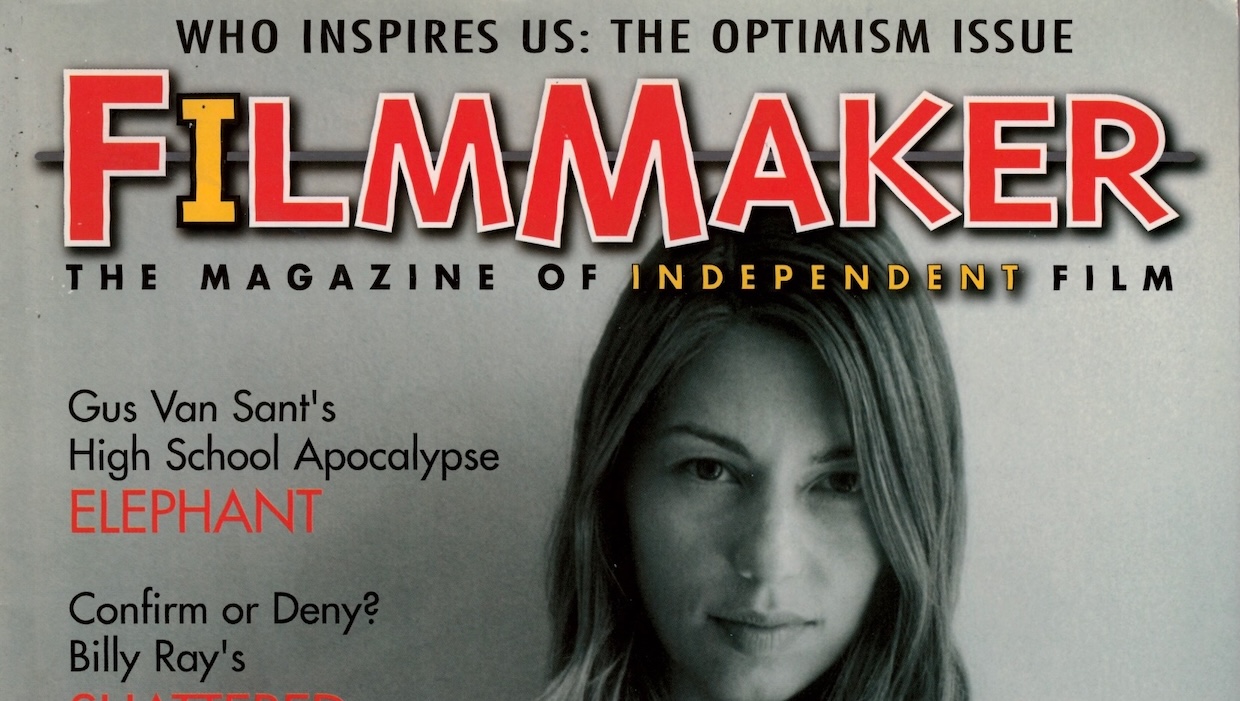
In his 2017 25 New Face profile of writer/director Ricky D’Ambrose (Notes on an Appearance, The Cathedral), Vadim Rizov described the filmmaker as having “a disciplined, honed gaze refined over years of self-tutoring.” I ran into Ricky recently and told him I was leaving Filmmaker; he responded by telling me that it was not just the magazine but one specific issue that was a vital part of his self-education. In editing this magazine, I’ve always been conscious of the educational breadcrumbs contained within each interview, as my own cinematic self-tutoring followed similar patterns, so I was excited to learn what Ricky took from that issue. — Scott Macaulay
Sometime in the fall of 2003, during my junior year of high school—the season of Operation Iraqi Freedom and Maroon 5 and long lines for The Matrix Reloaded—I walked into a Long Island Borders and noticed Sofia Coppola on the cover of a magazine. Inside, there was an interview about Lost In Translation, a piece on Michael Winterbottom’s In this World and, crucially, Scott Macaulay’s conversation with Gus Van Sant about Elephant, which had won the Palme d’Or that May.
I say “crucially” because it’s this latter piece that did something invaluable for me as a lonesome 16-year-old surrounded by the cultural glut of early aughts Nassau County, and it’s taken me years to appreciate this fully (perhaps because I was so quick to take it for granted). Here, suddenly, was my introduction to an American director working in what I’d later learn was a rather un-American way, seemingly free of punishing market imperatives and filmmaking by committee, drawing from a rich history of narrative and non-narrative films alike. One of those films had a long, funny name, difficult to pronounce and memorize: Jeanne Dielman: 23 quai du Commerce, 1080 Bruxelles.
Who else—and what else—would have made such an introduction to this kid, who had very few resources at his disposal beyond the shelves of Hollywood Video, in a house without books and at a school without mentors? And what other opportunity would there have been for that kid to come across a conversation that contained appreciations of Frederick Wiseman, Béla Tarr and Miklós Jancsó? I can’t say.
What matters most to me is the legacy of that encounter, its impact on the way I think about movies and the lessons I took from it: that there’s always more—more to seek out, to be challenged by, to learn and get pleasure from and to want to defend. It was a gift at a time when so much around me felt obvious and false. “How do you be a filmmaker?” it seemed to ask. Two decades later, I still want to know—and am still trying to find out.