Back to selection
The Way It Was
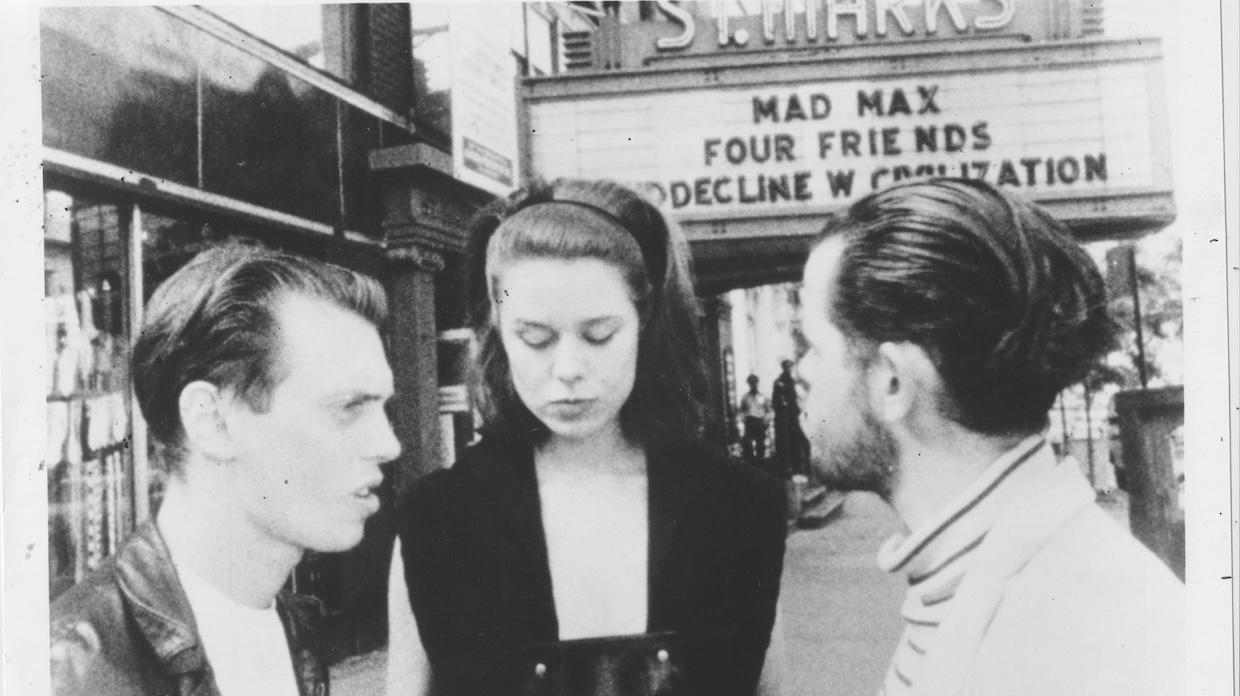 Steve Buscemi, Jessica Stuchbury and Mark Boone Jr. in The Way It Was
 Among the canonical pictures of my youth were the New York No Wave films of the 1980s, with my favorite being Eric Mitchell’s Underground U.S.A., a sardonic reworking of Sunset Blvd. starring gallerist Patti Astor. I saw it first on a New York public television station, then programmed it at my campus film club. As for Mitchell, I spot him around from time to time, usually at Anthology Film Archives, where I bumped into him last spring at a screening of another No Wave classic, Michael Oblowitz’s King Blank. He told me that he was in the process of restoring The Way It Is, the follow-up to Underground U.SA., and asked if I’d like to join him at a screening of the 16mm print at New York’s Public Library for the Performing Arts. So, a short time later, I found myself with Eric and his black-and-white images of a pre-gentrified New York East Village, where a melancholy tale of love and loss unfolded in the beautifully desolate streets, with Tompkins Square Park as some airy Italian piazza. As the film awaits a restoration by the Museum of Modern Art, I asked Mitchell if he’d remember its much-earlier moment of no-budget independent production. — Scott Macaulay
New York, summer 1984. Hot and humid, scriptwriting and hustling for funds to make a new movie, with no hope on the horizon.
After playing at midnight at the St. Mark’s Cinema for six months in 1980, my last film, Underground U.S.A., is invited to show around the world. It opens in Paris, London and Los Angeles and plays at festivals in Berlin, Portugal, Spain and Japan. A broadcast on UK’s Channel 4 and PBS’s Channel 13 ends its exposure and distribution. Now it’s time to make a new film. The script is in the works—a Western to be shot in Berlin—but three years have passed with no financing leads.
A phone call changes all of that. Peter Grass, a painter friend, wants to give me 20 rolls of 16mm film—black-and-white negative Plus X, fine grain. Now I can make a film. I pick up the canisters and store them in my fridge as I am told to.
Black-and-white Plus X is beautiful but very slow, so I am looking to come up with a story that can be shot all in daylight, with little or no additional lights. I re-read Orpheus, the play by Jean Cocteau, and screen Kurosawa’s Rashomon, which is based on a short story by Ryūnosuke Akutagawa, with the story told in flashback. A third film inspires me: Bertolucci’s La Commare Secca, based on a story by Pasolini, which tells the story of a prostitute mysteriously found dead in a public square in Rome.
I get to work. The story: A group of actors is rehearsing the Cocteau play on an outdoor ball court in Tompkins Square Park when one day the body of the young actress playing Eurydice is discovered dead in the park. In a series of flashbacks, the members of the troupe share their memories of the beautiful Eurydice and the life she lived before her death. The film recounts the encounters she had with the other member of the small troupe, led by Orpheus, her boyfriend, as they were falling out of love and finally breaking up.
Having no money, I decide to shoot the film with an Arri S fitted with a magazine, which can be rented cheaply along with some lighting equipment from Young Filmmakers on Stanton Street. I will shoot with no sound and later record the dialogue track to be synced up in post-production, the way early Italian neorealist films were made.
Putting the film crew together, I meet Bobby Bukowski at an NYU screening on 7th St. He is a cinematography major and has never shot a feature. I also meet Sue Graef, who will become the AD, script supervisor, dialogue and picture editor.
I cast a friend, the musician Kai Eric, as Orpheus, and Boris Major from the Hungarian theater group Squat as Eurydice. Steve Buscemi and Mark Boone, Jr., who at the time are doing a weekly comedy routine at Club 57 on St. Marks Place, are cast as Azrael and Raphael, the two assistants to Death, who will be played by Jessica Stutchbury. Rockets Redglare is cast as a struggling street comedian who had partnered with Eurydice before she drifted away. With his Italian charm, Vincent Gallo will be Orpheus’s cheating “best friend” Heurtebise, who has an affair with Eurydice and supplies her with the mortal drug that causes her death. French-born Edwidge Belmore as Aglaonice and Danny Rosen complete the cast.
The whole film, which I and the crew collectively title The Way It Is, will be shot on the Lower East Side, a few blocks from my apartment on East 3rd St. Having no transportation to move the equipment, I buy a large commercial hamper, which we fill with the camera and tripods. This allows us to move freely about the streets and set up scenes without notice or permits. Few indoor locations are used, and when shooting in cafes and bars I implement a traveling rig on skateboard wheels and shoot from the outside through the windows. The approach gives the image a wonderful reflection of the surrounding city, and there’s no need to bother the customers, no need to ask the owner for permission, no need for a boom mic and clap board.
Every day, I call the actors and tell them where the location will be. We’re able to store the equipment on 10th Street and 1st Avenue in Patti Astor’s Fun Gallery. The hamper is filled with the equipment and pushed to the location where the camera is then set up for the scene. No makeup, honeywagon or trailer.
Shooting takes a month. Upon completion, all the material goes back into the fridge. I have no money for processing.
A year later, I convince a friend, Daniel Sales, to raise the money so we can finally see the footage. It’s only then that we create an LLC and pay for the processing and post-production of the film. Fortunately, all the footage is good. An editing table is rented and installed in my apartment, where Sue proceeds to cut the film and match the dialogue. Bob Gould and other sound editors are hired to complete the sound effects and dialogue editing. To complete the film, I ask Vincent to compose and record the original soundtrack.
Once a print is produced by Guffanti Film Labs, one of the best black-and-white labs in the city, the film is screened in New York and invited to premiere at the Berlin Film Festival.
Now, 40 years later, and thanks to the support of the Museum of Modern Art Film Department, The Way It Is will be restored and finally available for viewing.