Issues
-
The Great Acceleration

A question lingering after 2020 political disruptions—whether the year is one of true change or simply a pause before traditional policies and behaviors return—is one that has also been uppermost on Hollywood minds ever since the day WarnerMedia torpedoed their own theatrical business. The bombshell decision, announced on December 3, to release Warner Bros.’ entire 2021 slate day-and-date simultaneously in movie houses and on HBO Max has prompted all manner of obituaries for cinema as we have long known and loved it. Independent hits such as Moonlight, Parasite and Get Out that have relied on the slow-burning fuses of word-of-mouth, […]
-
Render Time: Director Penny Lane Talks with A Glitch in the Matrix Director Rodney Ascher about His Reality-Questioning Documentary
In 1977, a characteristically fervid Philip K. Dick arrived to lecture at a science fiction convention and share his experiences from three years earlier, when he became convinced that the world was a simulation, one of many (“there may be 30 or 3,000 of them”) operating simultaneously, glimpses of which he’d seen. Clips from this speech (“If You Find This World Bad, You Should See Some of the Others”) and the Q&A that followed frame Rodney Ascher’s A Glitch in the Matrix. In the five-chapter (plus an epilogue) dive into the world of “simulation theory,” Ascher focuses on five subjects […]
-
A Question of Empathy: Viktor Kossakovsky on Gunda
Born in what was then Leningrad, U.S.S.R., Viktor Kossakovsky embarked on his journey to become one of the world’s most celebrated and elemental nonfiction filmmakers with a love of photography and a desire to explore the complexities of Russian history. After taking on various below-the-line roles at the Leningrad Studio of Documentaries, Kossakovsky directed his first feature, Losev, a black-and-white portrait of the elderly Russian philosopher Aleksei Fedorovich Losev. For his next black-and-white film, The Belovs, Kossakovsky turned inward, documenting a spirited but warring brother and his sister living on a farm in a western Russian village he had visited […]
-
The Doors of Our Mind: Director Florian Zeller on Memory, Mystery and The Father
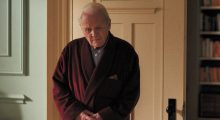
The following interview was originally published in Filmmaker‘s Winter, 2021 print edition. Among the techniques used to remember is one dating back to the Ancient Greeks: the Memory Palace. Facts, people, life events are “placed” within the rooms of a building, preferably a real one the remembering person is very familiar with. To summon the memories, the person mentally strolls from room to room, allowing the individual locations within the building to trigger the images placed inside. The Memory Palace’s ability to associate memories with place is given a devastating twist in French director Florian Zeller’s debut picture, The Father, […]
-
The Places Left Behind
Gianfranco Rosi’s nonfiction films are unified by their (often solo shooter) director’s precise framing. With images so strongly composed, the films’ status as vérité documentation has raised, if not controversy, at least questions about judgment, overaestheticization and potentially trivializing endangered subjects. That’s especially true of Rosi’s latest, Notturno, filmed over three years across the borders of Iraq, Kurdistan, Syria and Lebanon. From the opening shot, capturing with geometrical precision a group of soldiers running laps, Notturno elides names, battles and geographical precision into a group portrait of grief echoing across territorial demarcations. A site for war-scarred children in therapy, a […]
-
Dressing for the Extremes: Costume Designer Alexandra Byrne on Emma.
With their picturesque settings and unforgettable romances, Jane Austen adaptations have been cinematic staples for decades. The latest, Autumn de Wilde’s Emma, offers a colorful take on Austen’s 1815 tale of a young woman navigating relationships with the know-it-all confidence that goes with being, in Austen’s introductory description, “handsome, clever, and rich.” Much of the film’s distinctive sparkle comes from the costumes created by Oscar-winning designer Alexandra Byrne. Surprisingly, Byrne (one of whose first films was another Austen adaptation, 1995’s Persuasion) hadn’t read the novel before working on the film. “I really, really enjoyed it,” she says. “Sometimes, when you’ve […]
-
Voices in the Room
One Night in Miami stages a heavy-hitting, all-night-long hotel room conversation among Malcolm X, Cassius Clay, Jim Brown and Sam Cooke. In the aftermath of Clay beating Sonny Liston to earn the 1964 heavyweight title, the four talk in private about their fame and what to do with it in a white world. X challenges Cooke to take advantage of and subvert his palatable platform, to infuse his music for captive pale audiences with political outrage. During a year of moral reckoning, isolation and introspection, it was on schedule for those kinds of contentious discussions—about Blackness, protest and systemic inequality—to […]
-
Showing the Work: On Frederick Wiseman Subject Marty Walsh, Now the Biden Administration’s Secretary of Labor
If you live outside New England, and if you saw the movie, Frederick Wiseman’s City Hall (2020) was probably your introduction to Boston Mayor Marty Walsh, recently nominated to serve as Secretary of Labor in the Biden administration. And it’s a sustained introduction at that. Onscreen for about 45 of the film’s 272 minutes, Walsh is the living center of City Hall’s structure. Wiseman returns to his prepared remarks and public appearances like a buffer between less formal scenes of office talk and offsite labor, framing the mayor kind of like the loudspeaker in M*A*S*H (1970)—that is, if it had […]
-
Moving Through the Frame
Like The Searchers, Nomadland is bookended by a pair of doorways: on one side, the post-Baby Boom American Dream of domesticity and stability; on the other, the siren’s call of the wanderer, beckoning toward the unknown. In the film’s opening frame, Fern (Frances McDormand) stands in the doorway of a storage unit in Empire, Nevada. The Great Recession has swallowed the mining town whole; the 60-something widow takes one last glance at the remnants of her life, packed away in boxes, and climbs into her Ford Econoline van, headed toward the horizon. A year passes before Fern darkens another symbolic […]
-
On the Beat
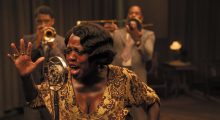
Chicago in 1927 was a fascinating, volatile place. The Great Migration, which saw an estimated six million African Americans leave the rural southern states for the urban north, was in full effect, and the Windy City was an important destination. By the mid 1920s, an estimated 100,000 Black people had settled in Chicago, making the city a hotbed for new cultural developments, especially in music—Chicago is widely regarded as the second stop in the evolution of jazz after New Orleans. The August Wilson play Ma Rainey’s Black Bottom tells one chapter of that evolution through a dramatic imagining of a single recording session […]