Back to selection
The Burnt Century: Clint Bentley and Greg Kwedar on Train Dreams
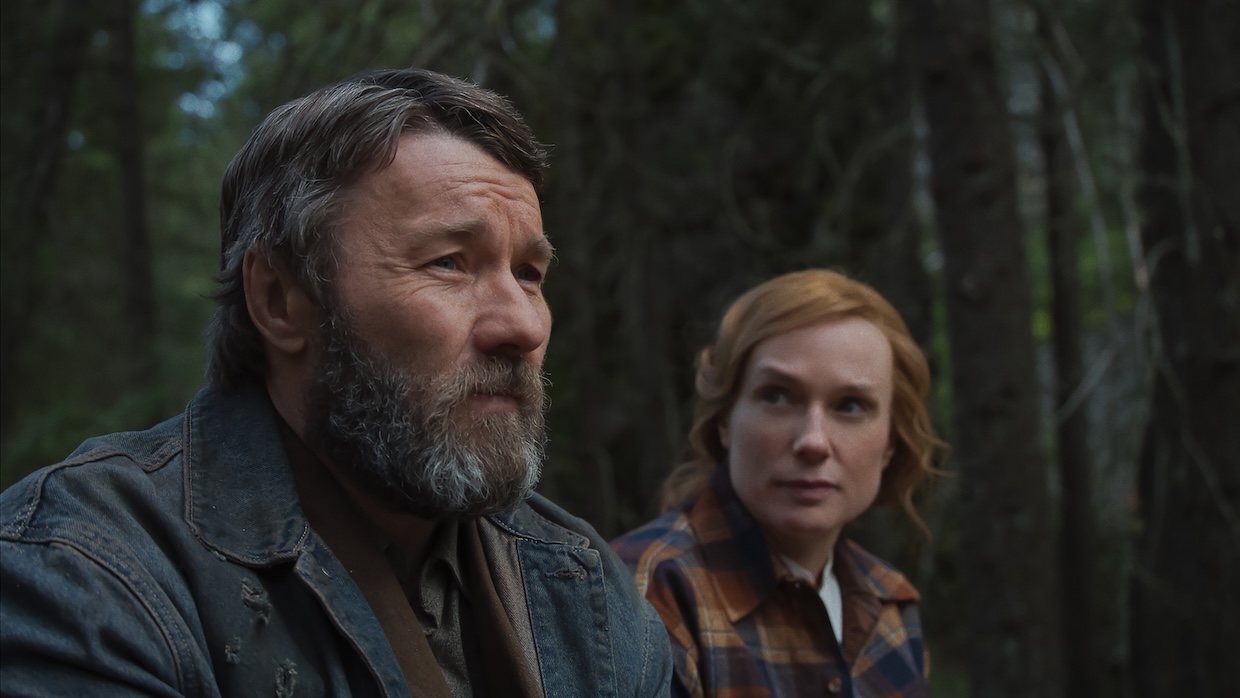 Joel Edgerton and Kerry Condon in Train Dreams (Courtesy of Netflix)
 Originally published in 2002, Denis Johnson’s novella Train Dreams chronicles the life of a logger who slips in and out of the world without a trace. An orphan with no knowledge of his birthplace or family lineage, Robert Grainier doesn’t have a history as much as he merely lives through it. He helps build the railroads that crisscross the country; when physically unable to maintain his arduous, itinerant lifestyle, he performs a series of odd jobs in his adopted home of Bonners Ferry, Idaho. He marries a woman, has a child and just as quickly loses them both in a massive wildfire. He witnesses multiple tragedies, meets many people without befriending any and sees modernity slowly change the face of a country. “Almost everyone in those parts knew Robert Grainier,” writes Johnson, “but when he passed away in his sleep sometime in November of 1968, he lay dead in his cabin through the rest of the fall, and through the winter, without being missed.”
The spare prose in Train Dreams is equal parts evocative and haunting, generating images of our country’s recent past during a time of immense change while exploring the perspective of a man more spectator than active participant in his own existence. Working with free indirect speech, Johnson successfully builds his vision of a bygone time across a little more than 100 pages, projecting an opaque mind onto a vivid landscape. Though its style may be deceptively accessible, Train Dreams evokes a complex ambiguity about the American character that Johnson submerges almost entirely in subtext, while the text itself embraces unsentimental portraiture, capturing the joy and tragedy of a rich lifetime that goes unremembered by the person living it.
It’s no easy task to render such a slender, dense text on a cinematic canvas. Writer/director Clint Bentley (Jockey), alongside his co-writer and creative partner Greg Kwedar (Sing Sing), felt like they could capture the spirit of the book while bending it to fit film’s distinct demands and their own creative interpretations, especially after they received a blessing from Johnson’s widow. Bentley traveled up to Washington, where he constructed an early 20th century world whose untouched soil will soon be marred by destruction and innovation. With the aid of a thoughtful acting ensemble, led by Joel Edgerton as Grainier and Felicity Jones as his wife, Gladys, he imbues his frame with warmth without sacrificing the melancholic menace that emanates from the source text.
Ahead of the select theatrical release of Train Dreams on November 7 and global Netflix streaming debut on November 21, Bentley and Kwedar spoke with Filmmaker about the difficulties of adapting such a beloved and unique text, traveling through Bonners Ferry to research and properly honor the area’s history and maintaining a well-honed independent process within a bigger-budget production.
Filmmaker: Had either you or Greg read the book before you came on board the film?
Bentley: It was my first [experience with] Denis Johnson. I’d never read anything by him before, and I just read it because it was one of the books to read that year and fell in love with it. Then, I started reading everything I could read from Johnson and became a huge fan. It was really special to me even before the producers who had the rights to it said, “Would you like to take a crack at this?”
Kwedar: Clint and I have worked together for over 15 years now. Usually, when one of us is going to direct a film, the film kind of “finds” [that person], then we invite the other into the journey. After Jockey premiered at Sundance, he was submitted a script of Train Dreams by the producers at Kamala Films. He read it and was like, “I feel like this is this magic opportunity to adapt it for the screen, but the only way I can see my way into it is if we were able to take the book anew and find our own way into it.”
Filmmaker: Did you ever had any kind of conversations with the Johnson estate during production?
Bentley: Greg and I are very much community-driven filmmakers. Independent film, a lot of times, because it’s so strapped, becomes very transactional with the communities that it works in. For Greg and [me], throughout all the films we’ve made, we’ve tried to be as inclusive and thoughtful as possible to the people we’re working with, and that was no different here. I made a point to reach out to Cindy [Johnson], Denis’s widow, to let her know that she could read as much as she wanted or be as much a part of the process as she wanted, but also that I would completely leave her alone if she didn’t want to be [involved]. She’s actually become a dear friend, came out to see some of the filming and is in the movie in a very brief cameo. She didn’t give much in the way of notes. She was very respectful and said, “You need to make your film out of this,” but was very supportive along the way.
Kwedar: I think it was the first book that he dedicated to her. It just says, “for Cindy Lee forever,” which is a special kind of distinction because I think this place meant so much to them. They had a cabin on the Moyie River, and that’s where this was written. So, we had a cabin on the Moyie River, too, and finished our first draft there looking at the same water that he did when he was writing it.
Filmmaker: You’re credited as a sole director on Train Dreams, while Greg was credited as the sole director on Sing Sing, but you are co-writers on both films. Whoever has the initial fire for a project, does that determine the difference in writing and directing credits?
Bentley: Also, the job. We don’t have a relationship where, like some filmmakers, both of them direct but then for crediting purposes one gets credited as the writer and one as the director or something like that. I directed Train Dreams, and Greg directed Sing Sing, and I think you can see those differences in our personalities or our tastes through those [works]. Often as a writer-director, you’re leading the charge on a project, and what I did for Sing Sing, and what Greg did for Train Dreams is like putting yourself in the back seat to support your friend as they want to make their film. I think it’s actually very good for the ego and for you as a person.
Filmmaker: Can you talk a little bit about the process of writing the script? Do you know how long it took?
Kwedar: Until the end of the edit. [Laughs.] That first draft, I don’t remember the exact length of time, but I remember benchmark moments through the adaptation. The first way I engaged with it, as a writer, was reading it pure and letting it wash over you, not trying to take notes down, not trying to make the movie in your head—just experience the work itself and see what sensations you walk away from it [with]. What lingers in the mind? Then, the second read was the read where I just went through and underlined anything that poked or inspired, whether that was prose or dialogue. The next phase was I lifted everything from the book that I underlined and put it in a document, just so that I could see it in another format. Then, we began.
One of the ways that Clint and I write is we talk a lot about the organizing structure, but we don’t get too into the particular details at first. One of the things that we like to do [when] we’re writing a script together [is] pick what we call “movements” of a script—a sequence of scenes that carry a broader chapter feeling— or go through some major sort of transition or character moment and divide up the process of what parts felt like they were calling to each of us. Then, we go away, work on our movements, and put it all together into a draft and read that draft. Then, one of us will revise the script all the way through on our own; then, the other will revise all of the script. Then, the final part of a process in working on a draft for us is we just get together and we argue over every little moment, comma, period, word, until we get to a place of, “OK, this is ready.”
Filmmaker: In one sense, the film is a very faithful adaptation of Johnson’s novella in terms of narrative action, but in another sense, it makes fairly substantial changes to the work. I was wondering where you initially saw opportunities for expansion or alteration to the text.
Bentley: Even before this project came along, I always wanted to do an adaptation. Just as any of us as being film students, you look at the adaptations that work and the ones that don’t, and the ones that I think work are when the filmmaker can let themselves tell a story and be a filmmaker and let the piece of work actually translate into another art form from the novel. The bellwether for me thinking about this project in particular was making sure that the spirit of the book couldn’t change. Outside of that, most of it was up for grabs.
Filmmaker: How would you describe the spirit of the book, then?
Bentley: It feels like life. It’s expansive and long and epic, even if you don’t do anything that’s “historically epic.” You don’t fight in some huge battle or invent some machine that changes the world. You might be a logger or a garbage person or a mail person or just work an office job, yet your life is an epic thing. I don’t think most of us fully understand the shape of our lives until we look back on it, and we’re trying to figure it out as we go along, trying to hold these two things in your hand at the same time: being present and living your life, while also trying to figure out, what does it all mean?
Filmmaker: The reason why I ask is because I think I had a very different read of the book than you do, which made seeing the film an interesting experience. I think I found Johnson’s book to be fundamentally more tragic than you did. In my estimation, it’s the story of a man who, despite his participation in reshaping the makeup of the country, comes to no understanding of himself in his life, and eventually becomes something of a passive spectator to events that befall him. His life becomes a series of incidents with him as this blank space in the middle of it. I think you adopted a more optimistic take of the book for the film, and I wonder how conscious you were of assuming that perspective.
Bentley: I think you are articulating what I want to say well. I didn’t want to let go of what I think is actually beautiful and special about it. This guy lives his life; there’s no real mark that he’s left on the world, in the way that we traditionally think about it, yet he lived a beautiful and poignant life. Maybe it’s the way that you turn and look at it that defines that. I don’t know if optimism is the right word, but that’s just how I look at the world. Unfortunately, I didn’t get the chance to talk with Denis, so I don’t know what he would say or not say about that.
Filmmaker: How long was the shoot?
Bentley: We landed right around 30 days.
Filmmaker: I’m curious about the split between location shooting and sets.
Bentley: It was almost entirely location shooting, and that’s something I wanted to bring into this film in terms of taking the things that I was trying to do with Jockey cinematically and expanding on them and evolving those approaches into a film like this. Even though [Train Dreams is] a period piece, and even though it was a much larger production, that was something that I really wanted to bring into it. The majority of it is on location. We built an actual cabin out in the woods. We found some logging camps and logging operations that let us retrofit their spaces, build some old shacks and things to turn it into an old logging camp and just move all the modern equipment out. We went out into the woods in Washington. There was only one or two days that we spent on a stage, and that was in order to get the effect that [cinematographer] Adolpho [Veloso] and I wanted to go for in the dream vision that he has of Gladys returning and what she experienced in the fire.
Filmmaker: Did Washington State come early as a primary location? It has such a specific character to it.
Bentley: I really wanted to, if at all possible, shoot in the place that the book is set. The book is set in the panhandle of Idaho and throughout Washington State, and that’s where I wanted to set it if we could. It was not easy, and we had to give up some things in order to get that, but I luckily had a production team [that] was willing to really take that seriously and help figure out how to do that. The Washington [film commission] was super open to having us there and helped make it work. We centered mostly in Spokane, then went out from there and did a week on the other side near Seattle.
Filmmaker: Can you talk about the things you had to give up?
Bentley: It’s a broader thing, which I’m sure you know quite well, which is in independent film, it’s a lot of times cheaper to go and shoot something in Eastern Europe than it is to shoot it in America. I think that’s a much bigger conversation and a much bigger issue that we’re facing in our industry here.
Filmmaker: Were you scouting locations based on sequences in the script, like in the scene where Kerry Condon and Joel Edgerton speak atop a fire lookout tower, or molding sequences based on what you had at your disposal?
Bentley: I come from a documentary background, and this is something that served us well on Jockey. If you find a great location, you figure out how to make it work in the film—an amazing location, something that feels cinematic and different, is priceless. There were quite a few great things that were found that way, including the snowy mountain. [But] getting very wonky, that fire tower was something that was written. We found this amazing fire tower on a great outlook that was just perfect. You wouldn’t have to do much to it to make it great for the film. Then, when we got close to shooting, it was snowed in, and it became clear at a certain point it was going to remain snowed in until we finished filming. I was devastated. We all scoured the entire state looking for another fire tower that would work, and for one reason or another [we couldn’t find one]. Huge props to [Alexandra] Schaller, our production designer, because we sat down—she, Adolpho, and I—and said, “OK, what if we found a spot where we could build a fire tower?”
So, we found a hill [where] we could build it just a little bit off the ground and on the side of this hill overlooking this, like, deep valley, but we did not have enough money to build a full fire tower. Adolpho and I, working with Alex, took this Ozu-like approach to it. We’re like, “All right, from the inside, we get one angle. Here’s what it looks like, and we’re just going to commit to and do the scene that way. Then, on the balcony, we can move around a bit more, but we’re still very limited.” It was really built hand-in-hand with Alex. We built half of a room, and when you’re inside the fire tower, there was nothing added in post with that shot. I took it for granted that people who were on the film with us [would know], but I found during post when I was showing scenes to people who weren’t there that day, they had no idea.
Filmmaker: Could you talk a little bit about filming the logging scenes and trying to achieve period accuracy? Did you have a consultant?
Bentley: That was something that I find really important from the beginning. Greg and I are both research hounds, so we were doing what we could with books during the writing process. But also, both when we were writing and then making the film, it was really important that I was talking to historians to make sure things were accurate. In the logging scenes, we did a combination of things. There are some moments where he’s cutting into these big old-growth trees that Alex Schaller and her team actually built. Even if we had gotten permission, morally, I could never cut into some tree that’s a thousand years old for a film. So, she built these trees that we could cut into, then we extended them up in VFX. Then, there are a couple of trees that come down in the film. For those, we went into areas that were being logged and found trees that were going to be cut down the following week, and they let us set up a camera while they cut them down.
Filmmaker: Do you know what the trees that you built were made of?
Bentley: I think it was some sort of Styrofoam. Then, they painted them. With some of them, they put real bark on the outside; with some of them they created bark and carved it. We had a few like things like that. They made a few stumps and things for us so that we could be in a space. I think that’s the brilliant thing she does as a production designer, even on a film like this, where a lot of [the film is] outside, she dresses areas as if it’s a set.
Filmmaker: Was there something you or Greg found in your research that you put into the film, or something that surprised you that you didn’t already know?
Bentley: We went up to Bonners Ferry when we were writing, which is where the book is set, and there’s a little museum there. We saw old photos and newspaper clippings, and one that stood out to me was [of] these huge sturgeons that people would fish out of the rivers. They’re like 10- and 11-feet long. It’s an image early in the film, these people standing around this giant sturgeon that’s hanging from a hook. Without being too overt about it, I wanted to talk about ecology and what our endless appetite for progress does to nature. It felt like such a potent image. You’ve got this prehistoric giant fish that now [is very rare], and the Kutenai people who live in the area are actually reintroducing it. They have these fisheries where they’re growing these sturgeon and trying to reintroduce them into the rivers in a big way.
Kwedar: [When we] went down to a Kutenai fish nursery where they were helping reintroduce sturgeon back into the rivers, you could hold a baby sturgeon in your hand. When you’re looking at it in this little pool of water in your hand, you’re seeing [a species] that is literally 200 million years old. That’s how long that that species has been on this planet. It’s like you’re looking back into time, you know?
Filmmaker: When did the idea of using Patton as a narrator come into play?
Kwedar: That was very late breaking. I believe the narration got laid down right before the premiere at Sundance. That’s also part of the nature of chasing a Sundance premiere. Sometimes, the way it crunches a post timeline is insane; [sometimes,] it’s literally getting on a plane with a hard drive to a festival premiere. I don’t know if it was that intense, but it came down to the wire.
It was one of those magical things we always talked about. If we were going to help channel the voice of Denis Johnson, you needed to experience the way he used prose, and to help the film achieve its structure in the way that it moves through and circles around time. We used a lot of the actual prose from the text in the direct narration, but then the narration took on a life of its own. I attribute most of that to Clint because he’s also an incredible prose writer. When I watch the film, I can’t tell what narration was ours and what was Denis’s.
Filmmaker: Talk about shooting the flight sequence. Was it difficult to get a plane that small?
Bentley: It wasn’t actually that hard. The community that has those old biplanes are very passionate, and they’re very excited to put them in a movie. Yellow was Gladys’s color in the film, and in terms of color theory, [the plane’s color] was another way to subtly feel her presence throughout the film. Then, this plane was presented, and it’s a perfectly yellow plane. I wanted the pilot to be a young woman, if we could find somebody who had the right credentials and could also say lines, which felt maybe like it would be impossible because it’s such a narrow window. We found this great pilot, who was also named Amelia, and it all worked out very well.
Filmmaker: I know animals are famously difficult on set. Did the chickens or dogs pose any problems?
Bentley: You don’t really direct chickens. You just kind of put them there and move around them. It’s funny, the puppies were the easiest to work with. I don’t know why that is. I would have never guessed that, but the puppies were incredibly easy. Dogs are like kids, where they have their great days and bad days. The horses were incredible. I didn’t work with any movie horses on Jockey. We were working with racehorses and going with them. But on this one, it was wild. You actually have these trained horses, and you’re like, “It’d be great to have this horse lie down.” The trainer brings the horse over, and he snaps his finger and points at the ground; the horse lies down on the ground. It’s just wild.
Filmmaker: How did you find the train cars?
Bentley: There aren’t many old steam locomotives left in the world, at least in this country, that are operational. [But] we found this museum [in Snoqualmie, Washington] that was open to us filming with their train. They had this incredible steam locomotive, and also three or four cars that they pulled behind it, and they do tours with people. They were kind of apologetic because they’re like, “I’m sorry, our cars aren’t uniform. One is from the ’50s and one is from the ’20s, and one’s a box car.” We were like, “Dude, this is perfect. This is exactly what we need.” We just filmed different sections of time in each of the different cars, and Adolpho and I tried to find a different language for each one, where you can feel the difference in each one.
Filmmaker: Filmmaker actually interviewed Adolpho, and he talked a little bit about some of the film’s visuals in terms of tone and lighting, like Dorothea Lange and Tarkovsky. Were there other visual signposts for the film?
Bentley: We were very much on the same page from the beginning in terms of who we were looking to. I put together my list of influences and Adolpho put together his deck, and we presented each other’s decks, and Tarkovsky was a big overlap even from the beginning. He was a huge influence in terms of the way he approached time periods. When I watch Andrei Rublev, it feels like a document of a time rather than some sort of period piece or a theater piece.
Filmmaker: Greg, how much were you on the set of Train Dreams?
Kwedar: For the first three films that we made together, we were there every day for each other’s projects. Now that both of our filmmaking careers have evolved, how do you still be there for someone if you can’t be there be there? When Clint was shooting Train Dreams, I was on the press tour for Sing Sing. You’re in four cities in five days, your head is totally upside down; you’re in hotels, and you walk into a wall thinking you’re going to the bathroom. I was seeing dailies when I was in all these hotel rooms and watching Clint direct this movie from a succession of stops on the promotional tour. Obviously, we’re the red phone for each other, and we were always in touch and talking through the process, [but] it was really surreal to then come onto the set at the very end, when I was at the Seattle International Film Festival with Sing Sing. It was like [the film’s use of] trees in the script—you could go away for a decade and come back, and the tree is as tall as a house now. Seeing Clint, the growth that he had, and the confidence that he had handling a movie of that scope, I was in awe. I felt like a total stranger, wandering around the set and being like, “Wow, the craft services are really good here.” We come from such an indie background, [and this] was a much bigger production than we had ever been a part of, but it still felt like Clint, Adolpho and Joel and the cast were kind of getting away with something, going off in the woods and making their own little film.
Filmmaker: With the acknowledged understanding that filming any movie requires solving a series of challenges, is there an example of a particularly challenging scene or day during production that comes to mind, and how did you tackle it?
Bentley: Anytime you’re trying to make a film at all, it’s going to be a hard shoot. But we were trying to make something in the elements, and we were trying to really expand what we were able to do. It was always difficult. One thing we really wanted to do that was important was the scenes post-wildfire. There was this area nearby that a wildfire had gone through outside of Spokane when we had started prep back in the fall of 2023. It was very surreal and troubling, and it felt like it would be almost strange not to film in it [or to] try to recreate that somewhere else given that it just happened. It was really difficult and hard to shoot in this place that’s kind of an ashen wasteland.
Filmmaker: Adolpho mentioned that you used a massive structure of lights when shooting the fire scenes. Can you talk about how you came up with that?
Bentley: All the things that Adolpho and his team figured out on a practicality front on the fires was amazing. We wanted to shoot [the film] with just anything that was lit by fires or candles. We didn’t want to cheat it. So, any scene in the movie that’s them sitting around a fire, it’s lit by an actual fire. We wanted to put the actors in the world as much as possible. In that big fire sequence, we filmed in a forest that had been gutted by a wildfire with a mix of practical fires, with a fire-and-safety team and all that, that were set around the path that Joel was going through, and then things beyond that were going to be built and enhanced by VFX. I could spend an entire article talking about our VFX supervisor, Ilia [Mokhtareizadeh], who’s just brilliant. But in working with Ilia, we were planning out how much of this is going to be practical and how much is going to be built in CGI in the back end. I wanted this image at the end where he can go no farther, he’s gone as far as he can, the heat of the fire and the wind of the fire is pushing him back. [There’s] no way to practically create a wall of flames, so they found this bank of lights. It was on the road with… I don’t know if it was AC/DC. It was on the road with rock shows, and they let us borrow it for a couple days to set it up, and that became the base from which we built the big fire.