Back to selection
Perfect Eleven: Harry Shearer Remembers Rob Reiner
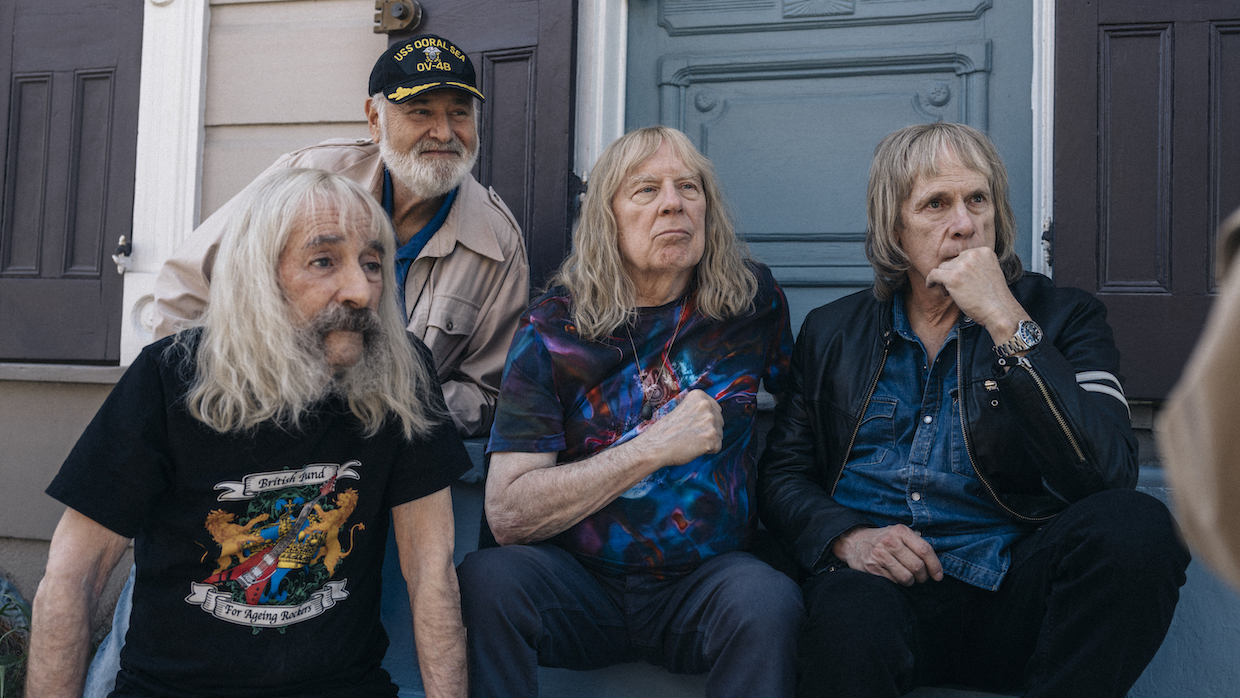 Image: Kyle Kaplan, courtesy of Goodbye Cleveland 2, LLC.
 I first became aware of Rob Reiner as a member of The Committee, an improv group that began in the early 1960s in San Francisco and then, as some members moved south where the showbiz work was, opened a branch in Los Angeles. Of course, I became more aware of him, like most of America did, as a character derisively known as “Meathead” in the ground-breaking sitcom All in the Family.
But he started making an impact on me personally when he’d show up to see his friend David L. Lander (later TV’s Squiggy) as part of the comedy group I was in. It was called The Credibility Gap, and we did a regular slate of shows at what was otherwise a folk club on Melrose Avenue in Hollywood called the Ash Grove. It was Rob’s laugh—heartfelt, frequent, just short of raucous—that made me like him before we even had met. He called me “Heshman,” a derivative of Herschel, the yiddish variant of Harry. I just called him Rob.
As the Gap was breaking up, I started a relationship with another member of the Reiner family, and so I would attend dinners at the family house. Rob was there, as was his father Carl, also a comedy legend. I had never before been a semi-regular at a place so full of unstrained, gentle good humor.
Around this time, Rob approached me to help write and produce a TV pilot for ABC called The T.V. Show. He had a script he’d written with a partner, but he thought it needed a trip upstairs. I brought in two guys I had just seen in a pair of wonderful comedy half-hours, Tom Leopold and Christopher Guest. Together, the four of us rewrote The T.V. Show in Rob’s office at the Columbia Pictures lot in Hollywood. These were days full of laughter, the kind that rockets around the room when genuinely funny people work together with ease.
Shortly after that show aired—dumped in a late-night midsummer slot by the network in response to a sketch they had originally approved—Rob guest-hosted The Tonight Show Starring Johnny Carson. He invited Billy Crystal and me to perform that sketch on the show, an extremely generous gesture, affording me my first and only appearance on that legendary broadcast.
The T.V. Show included a sketch featuring a faux rock band, Spinal Tap. Rob, who had directed a TV movie, thought there was more to the Tap story, and he was able to get money for us—Rob, Chris Guest, Michael McKean, and me—to gather in a Beverly Hills hotel room and start banging out a first draft of the script. Early on, we realized the pseudo-documentary nature of what we envisioned could not be reduced to paper, so Rob organized a shoot to do a demo version of what that film would be like. The four of us toured Hollywood studios, showing the demo to perplexed studio executives. Had Rob not had a connection with All in the Family producer Norman Lear, who by that time was running a small movie company, Spinal Tap would have died as a demo.
Rob’s stroke of directorial genius was realizing that the film wouldn’t look like a real documentary if it was shot by a traditional director of photography. He decided to select an actual documentarian, Peter Smokler. We all saw the film he made about the head of the self-improvement sect EST trying to become a racecar driver. It was real. And funny. A perfect choice.
And, per Rob’s choice, the auditions for the film were a group affair. We all gathered around a table to play with the actors, and when the sparks flew, we all knew we had our fellow cast members.
Doing the film seems, in retrospect, like a whirlwind of activity—writing the non-script (stage directions, but no dialogue), recording the music, rehearsing, and filming three-plus weeks. Rob’s early edit elicited near-unanimous reactions from preview audiences: “Why did it stop being funny halfway through?” That was a reaction to a focus on the emotional struggle between characters David and Nigel, reminiscent of the sentimental nature of Rob’s TV movie. A re-edit produced a demonstrably better product, funny straight through.
And then… I went to New York to be part of a less enjoyable TV comedy production. My relationship ended, not from my own initiative. And my connection with Rob seemed to suffer as well. Nothing was said, but we largely lost touch, to the extent that when he attended the premiere of the aforementioned late-night show a year later to support Chris Guest’s debut, he seemed to me strangely remote, a real 180 from his normally approachable and affable self.
Rob went on to direct his string of successful movies. I joined the cast of an uber-successful animated TV series. The occasion for our reuniting was the outcome of a legal action I had filed against StudioCanal. I became the owner of the IP of Spinal Tap. Soon enough, Rob had agreed to direct a second Tap movie.
Once again, the four of us were gathered around a table, first in a windowless conference room in Santa Monica, then in the sun-splashed dining room of my Santa Monica home, throwing out ideas and jokes while Rob wrote down the choice ones on 3×5 cards and pinned them to a corkboard. At some point, he felt we had the makings of a film.
He then went through what seemed, from a slight remove, like an arduous process to raise money for producing the movie. He hosted a seemingly amiable dinner for the prospective funders, to which I was invited, at a prominent New Orleans restaurant. And he decided to shoot the show in New Orleans, where my wife and I live most of the time.
In one of the most famous gags from the original film, Spinal Tap orders up a Stonehenge stage set that, when delivered, turns out to be disappointingly small. In the years since its release, Spinal Tap did several tours and came up with new variations on the bit. For example, when we played Royal Albert Hall, we showed video from outside the venue of our vain attempt to get the Stonehenge set into the building. Turns out, it was too big for the room. So, for the movie sequel, it was Rob’s idea to have a perfectly sized Stonehenge… which just happened to break loose from its moorings to crush us all, along with Sir Elton John.
I was recovering from long Covid during the shoot. Rob was extremely gracious about making allowances for my somewhat weakened self. And we started having conversations again, including ones in which he shared news about his sudden loss of vision in one eye. We were people who had gone through life’s wringer and, hopefully, come out the other side.
Two periods of solid and menschy friendship, separated by a few decades and brought to a shattering end by a family crisis he never mentioned. Sadly, I will never again answer the phone to hear his cheerfully melodic greeting, “Heshman!”