Back to selection
Reel to Reel: Is “Content” So Different From Edison’s Early Cinema?
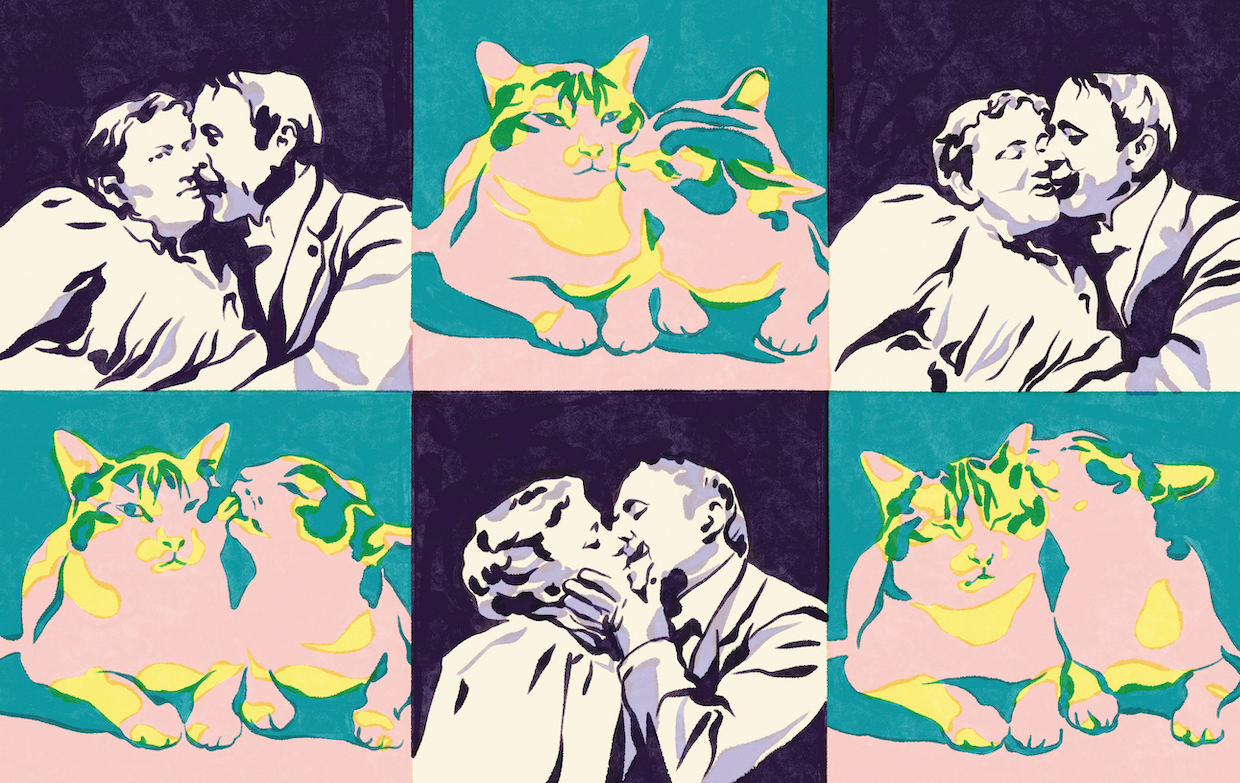 Illustration by Johanne Licard
 The churn is relentless. The demand, insatiable. The output, rushed and raw but undeniably compelling.
Working with cutting-edge communications devices, a rotating cast of tinkerers comes together each day to produce new pieces of short-form visual entertainment, racing to keep up with an attention economy that demands new thrills, new sensations, new captured moments that, often enough, go on to permeate the wider culture. Sometimes, these snippets of footage simply isolate and examine something universal from real life; other times, they tell a story. Naturally, there are collaborations with commercial interests and guest appearances from celebrities hoping for a quick hit of marketing.
I’m speaking, of course, of Thomas Edison’s motion picture studios, which pumped out thousands of (mostly) short films between 1894 and 1918 to feed the beast of early cinema, from kinetoscopes and nickelodeons to the first movie houses. Long before viral short-form videos turned TikTok and Instagram into pop-cultural powerhouses, these amusements—some as simple as a slow-motion sneeze or a looped kiss—were designed to blow the minds of as many people as possible. The lofty artistic aspirations mostly came later.
Today, as the film industry faces existential threats from every direction, it’s common to sneer at the world of “content creators” as just another contemporary debasement. How can we expect our kids to sit through three-hour epics when their brains have been fried by 20-second clips of teenagers playing video games? And yet, if you squint, you’ll find parallels between the current state of social video and the dawn of moviemaking. If that bygone era of frantically catering to the lowest common denominator bequeathed us all the riches of 20th- and 21st-century cinema, it’s reasonable to ask: what cinematic universe is being born today?
*****
One of the most heralded examples of early cinema, Edison Studios’s The Kiss, originated as a newspaper stunt. In December 1895, controversy erupted over a theatrical production of Carmen in which the actress Olga Nethersole kissed several cast members in a manner that, at the time, seemed shockingly explicit. Not long after, May Irwin and John C. Rice responded with an over-the-top kiss of their own in a comedy called The Widow Jones. They “hammed it up,” according to documentarian and Yale University professor Charles Musser. Seizing on the publicity, the New York World newspaper asked Irwin and Rice to recreate their kiss for Edison’s camera.
The Kiss was shown on a loop, not unlike a GIF, and quickly became a massive hit. The looping nature of the clip—“kissing over and over,” as Musser puts it—made it especially apt as a send-up of Nethersole’s long, drawn-out stage kisses. In essence, it’s a pop-cultural spoof that took on a life of its own. Is that so different from a kid today dancing around like Wednesday Addams on TikTok?
According to Musser, The Kiss had a transformative effect on society. “Kissing in public became acceptable” as a result. It also spawned “many imitations over the next five years,” a protoexample of viral memeification.
Many of the early shorts, Musser explains, were “tied to particular events or subject matter, or a particular opportunity,” and “things were quietly sponsored.” An early director for Edison, James White, worked in many genres, including “train films.” While tales of audiences shrieking in fear at the Lumiere Brothers’ The Arrival of the Train (1896) may be overstated, there are reports that such later efforts as White’s The Black Diamond Express (1896) did provoke very visceral reactions. Realizing that White’s films amounted to free advertising, transportation companies began comping his train tickets and setting him up with no-cost production sessions.
It was the dawn of what today’s marketers would call “collabs.” Eugen Sandow, a celebrated strongman on the vaudeville circuit, made several short films with the Edison company in 1894, timed to the release of his memoir. “Was it just the film promoting the book? No, it was also all the newspaper articles about the films,” Musser explains. Wild West stars Annie Oakley and Buffalo Bill gave their careers a contemporary boost by performing for Edison’s cameras. And May Irwin dedicated the next phase of her career to riffing on the meme she created with The Kiss. “It became a cultural nexus,” says Musser.
When you think about the Edison company striking the lights each day as new guests came in to shill for themselves, it’s hard not to fast-forward mentally a century and change to something like The Hype House, the now-shuttered communal home and production facility for Instagram and TikTok influencers where prominently displayed energy drinks and loaner vehicles paid the bills.
*****
Bill Morrison, an established filmmaker whose previous work has involved plundering forgotten archives for such memorable features as Decasia (2002) and Dawson City: Frozen Time (2016), switched aesthetic gears considerably for his Oscar-nominated short film Incident, released in 2023.
On one level, the project functions as news. It takes bodycam footage from the Chicago Police Department and other surveillance cameras and cuts it together to detail the police shooting of a man named Harith Augustus and its immediate aftermath. The film makes plain how unjust Augustus’s death was and documents the police force’s immediate reflex to agree upon what can only be called a cover story.
Morrison, the subject of a major MoMA retrospective in 2014, has a background in fine art. While he does not manipulate any of the footage, he deploys split screens, makes significant use of silence, and moves backward and forward on the timeline to create an inter-narrative conversation.
“I wasn’t thinking of it as entertainment,” Morrison explains, “but I was thinking that there are enough weird elements to draw the viewer in. There’s that seagull passing by, the use of silence, the quad screens. There are events. The shooting happens, [the cop] basically has a nervous breakdown and has to be brought somewhere else. Now, you’re in his world, in his car, freaking out, and then they turn those cameras off, which brings you back to the scene where somebody wants to see the corpse. It’s his friend or co-worker, and he flips out. It took time finding those beats, [realizing] this is really rich, then finding a way of telling this that hasn’t been told before.”
Incident is an important and disturbing film, but it draws much of its power from aesthetics. Somewhere along the way came a transubstantiation. Raw news into lasting art.
Of the materials he used, Morrison, who is currently working on a similar project involving border patrol footage, explains, “There’s a moment where it gets declared in the public domain. Until then, it’s evidence, it’s internal, it’s not cinema—it’s data.” Only after it passed a “legal rubric” did it become available to him as a filmmaker. When I ask if this is a harbinger of a new art form, he is a little cagey and returns to the métier of his previous work: early cinema.
Citing what is widely considered the first motion picture, Eadweard Muybridge’s 1878 work The Horse in Motion, he notes that its importance is rooted in something ineffable: “People were looking for that magic moment when the four hooves were off the ground. Somehow, all these tiny little photographs [moving] in infinitesimal increments were going to show something about our nature that we hadn’t seen. But it’s sort of like reading the tea leaves. Do you think that the hooves were off the ground, and there’s a moment when a horse is suspended in the air? Or do you think there’s always a hoof on the ground?”
He adds, “It was quickly understood that maybe this black-and-white fuzzy stuff was going to have a future once it was in color, had sound, had editing and, you know, dealt with sex. I think there was a lot of excitement about what the future of cinema could hold back then.”
*****
Jason Eppink, who teaches digital media at Elmhurst University, was early to the cause of scrutinizing internet detritus for signs of artistic merit. When confronted with any short work, even an ad interrupting a social media scroll, he asks one question: “Was this an effective aesthetic experience?”
That line of inquiry inspired him to mount a 2015 exhibition at the Museum of the Moving Image in New York City titled How Cats Took Over the Internet. The small-in-scope but wide-in-impact show highlighted and contextualized several moments that were already “internet famous,” such as “Keyboard Cat” (2007); the original “Happy Cat” (2007), perhaps better known as the O.G. “I can has Cheezburger” cat; and four-legged celebs like Maru, Grumpy Cat, and Lil Bub. The show documented an earlier era of media consumption, almost as different from our own as Thomas Edison’s New Jersey was from Hollywood’s Golden Age. Pre-2008 internet culture was defined by “someone who stayed in their office with their desktop computer and CRT monitor and sat with a cat,” Eppink observes, “versus a more active lifestyle, which would require what we now have in our pockets.”
In other words, technology is what’s driving our visual culture, the same as it always has. The same innovations that enable craven stunts to hack attention can also sustain great works of art—and even facilitate revelations that radically upend established power structures.
Might we someday look back on this era as the fertile if chaotic primordial soup that birthed our cinematic future? Eppink, for his part, is pessimistic. “The short dopamine loop cycle of scrolling the waterfall, seeing things for a few seconds, encourages disgust. I suspect that there’s nothing very positive about this network system we have. It instrumentalizes and preys on our worst instincts,” he says.
But Professor Charles Musser isn’t quite so bleak. “There’s just a huge amount of stuff that I think inevitably will get lost,” he surmises, “but other things will, for one reason or another, be preserved—and have a profound cultural impact.”
To bring it back to Thomas Edison, let’s recall one of the inventor, industrialist, and futurist’s great quotes: “To invent, you need a good imagination and a pile of junk.”