Back to selection
Dreams Deferred: How Iranian Filmmakers Pursue Liberation Under Unbearable Constraints
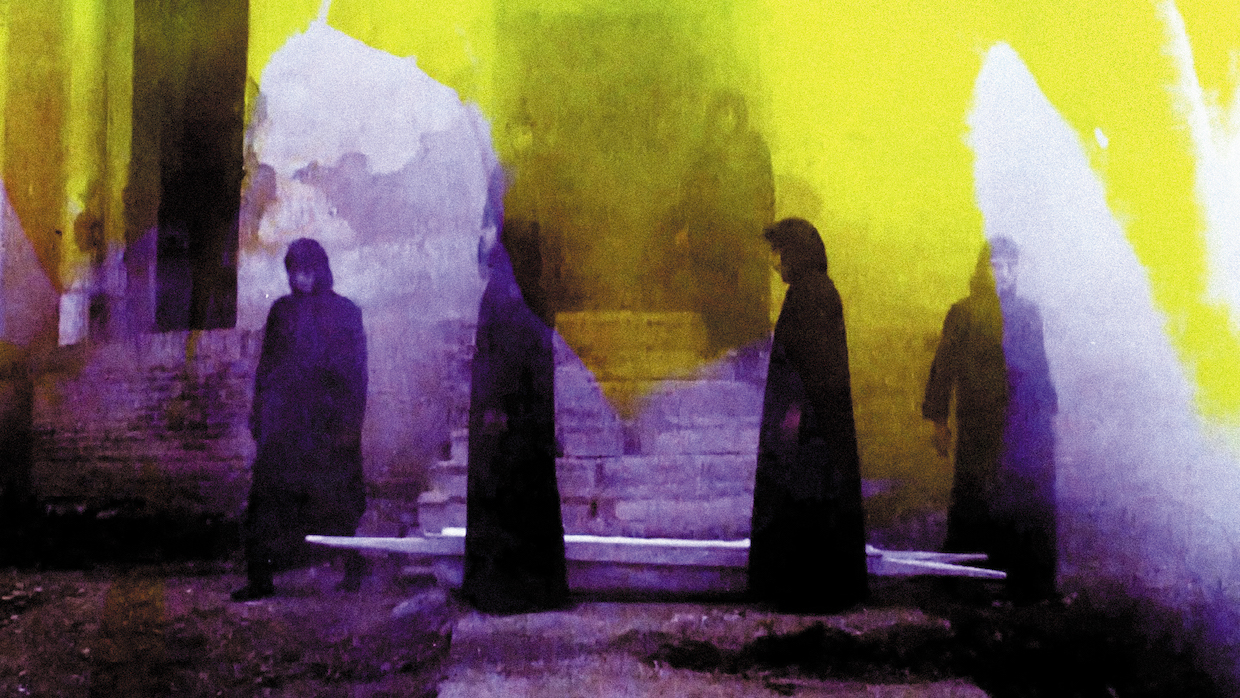 Daria's Night Flowers. Courtesy of Square Eyes.
 The people of Iran find themselves suspended in a historical moment of great uncertainty. On December 28, 2025, in the midst of a major economic crisis exacerbated in part by U.S. sanctions, shopkeepers and vendors in several commercial centers throughout the country went on strike. The protests grew larger in number, culminating in early January as Iran’s largest uprising since the 1979 Revolution. The Islamic Republic of Iran (IRI) responded by imposing an internet blackout to facilitate the indiscriminate murder of protesters and civilians alike. Thousands were killed in the largest massacre in the nation’s history, and the periodic protests that had broken out since have been put on hold in the wake of airstrikes from Israel and the United States.
The protests in the new millennium that led to this moment have not given the Iranian people a clear vision for a liberated future. How can Iran’s citizenry imagine a nation free from the brutality of the Islamic Republic of Iran? Does that conception entail a regression to a monarchist past, reinstating the son of a man whose own surveillance apparatus laid the groundwork for the oppressive tactics of the regime that replaced him? And in a country globally beloved for its cinema, what does the medium do to address these fraught questions?
Iran’s cinema, both state sanctioned and clandestinely produced, has rarely opted for a direct approach toward providing any clear-cut answers. At its best, the medium can deploy a poetic naturalism that subverts the kind of narratives parroted by the IRI and by neocon war hawks. What some contemporary Iranian cinema has done is evoke a feeling of historical displacement, of a people who have tirelessly struggled for their freedom and dignity, and in the process contend with one another’s place in that struggle.
A clear-cut case would include last year’s Sundance premiere Cutting Through Rocks, a documentary that condenses seven years in the life of Sara Shahverdi, the first woman councilmember in the northwestern village of Bazin. Shahverdi’s outspoken demeanor provokes the men in her village and inspires the young girls, who aspire to a life beyond the constraints of arranged marriage at ages as young as 11.
What distinguishes Shahverdi’s story from past dramatizations of gender apartheid in Iranian film is the way directors Sara Khaki and Mohammedreza Eyni examine the banality of systemic misogyny in all corners of Iranian society. Shahverdi’s intercessions in marital disputes over property ownership provide a poignant, humane glimpse into the struggle of women in Iran.
The film was shot between 2017 and 2023, in the years leading up to and ultimately coinciding with the infamous murder of Jina Mahsa Amini. A Kurdish-Iranian woman, Amini was killed by the regime’s morality police for allegedly not wearing a headscarf correctly. Her death in custody, in September 2022, sparked massive protests that were the largest seen in the nation since the Green Movement in 2009. Amini’s name is never mentioned in the film. Yet, the seismic demonstrations that seized the attention of the global community undergird the documentary’s chief concern: women holding positions of power in a political system that weaponizes sexism to pit impoverished patriarchs against girls and women.
What has been lost in much of the western narrative surrounding Amini’s murder is her Kurdish identity and the historical precedent set by Kurdish-Iranians in their struggle for freedom. The Kurdish people in western Iran have been engaged in some form of separatist struggle with the governments of first the Pahlavi monarchy and then the IRI for more than a century, and the Democratic Party of Iranian Kurdistan (PDKI) has been engaged in a series of skirmishes that reached their peak between 2016 and 2020. Naghmeh Abbasi’s short, Landscape Suspended (2022), probes the deliberate obfuscation of this history through an allegorical study of the Shaho Mountain where the nomadic Kurdish people known as the Havar Neshins reside. Abbasi’s survey of the rocky valleys surrounding these mountains is accompanied by archival photographs of the mass exodus of villagers from Mariwan by the Revolutionary Guard in 1980, shortly after the revolution. Sprinkled throughout is voiceover from a female narrator quoting Farzad Kamangar, a Kurdish educator, journalist, and poet executed by the state in 2010.
A history of political struggle is condensed in the shadow of these mountains, and it’s in the traces left by Kurdish guerrillas and nomads that the film poses its most urgent question of how a cultural and political archive is formed. In the midst of internet blackouts that keep Iranians isolated, the recent events that have gripped the nation in political turmoil since late December 2025 have pushed to the forefront how information is withheld and how control is ensured by the state. Probing the limitations of the archive has also characterized the work of Maryam Tafakory, whose latest short, Daria’s Night Flowers (2025), plumbs a familiar array of work by Iranian auteurs like Dariush Mehrjui and Bahram Beyzaie to craft a fictitious narrative concerning two women who conspire in a bloody plot of revenge against one of their brutish spouses.
Tafakory’s corpus is defined by a preoccupation with the illegible and the illicit in Iranian cinema, but Daria’s Night Flowers is her most furious work, fully embracing queer love as an instrumental form of resistance against the state. Where Tafakory’s vision of cinema harbors possibilities for reconstructing suppressed interpersonal narratives, Jafar Panahi’s feature It Was Just An Accident (2025) opts for a decidedly more classical approach in its parable of vengeance. Panahi weaves in subtle details, like the Azerbaijani identity of the mechanic who kidnaps his alleged torturer, or the conscription of the perpetrator in question into military service in Syria. By confining his characters within Tehran and its outskirts, Panahi illustrates the tragic conundrum facing the victims of the IRI: potential for forming solidarity against oppression remains possible, but the lack of robust networks of resistance currently makes revolution a tantalizing prospect just beyond the Iranian people’s reach.
That uncertainty leads us to the present, as the situation in Iran and its neighboring countries worsens by the day. If anything can serve as a counter to the horrific violence enacted upon Iran’s people, it will be rooted in a system that enables a broader understanding of the nation’s history of struggle for freedom and the eclectic coalitions that have vied for that freedom. Cinema cannot serve as a substitute for that process, but if these films are any indication, it can serve as a signpost toward self-empowerment and, goodness willing, liberation.