Back to selection
How Ridgewood Became New York City’s Communal Cinema Hub
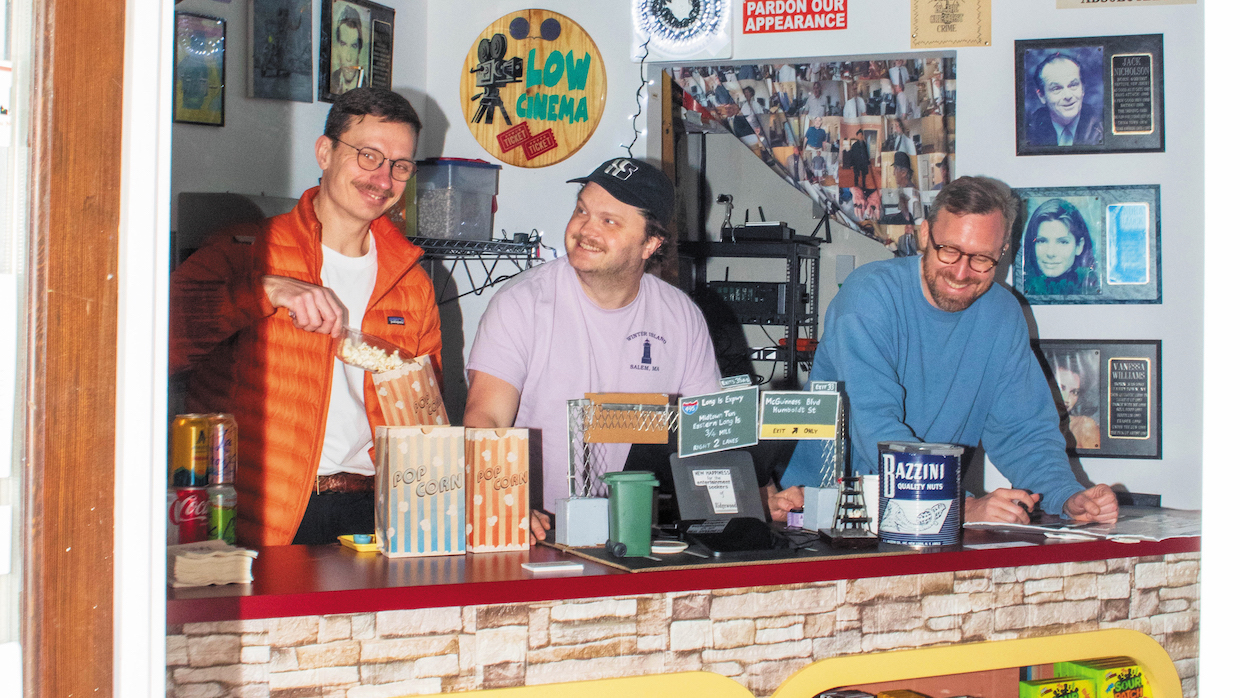 Photo by Steven Gonzalez
 A white, windowless storefront in Ridgewood, Queens, has the distinction of being the neighborhood’s first new cinema in nearly 100 years. Co-founded last year by filmmaker John Wilson alongside collaborators Davis Fowlkes and Cosmo Bjorkenheim, Low Cinema features 42 seats (sourced second-hand), digital and 16mm projection, and even a papier-mâché E.T. Handmade by Wilson, the cheerful alien hovers beneath the ceiling by the front door.
The day I visited the microcinema in late February, I was greeted by a veritable cinematic symphony. Corn was freshly popping, ticket holders poured in for an afternoon showing of Nirvanna the Band the Show the Movie, and an iPad trilled behind the counter. The crew was road-testing a new QR code system for scanning tickets, which had previously been verified by staff glancing at attendees’ phones. “I think it’s more psychological for the audience member to have their purchase validated by a beeping sound,” Wilson says.
“We actually had to ask our developer to add a beeping sound,” Bjorkenheim clarifies. This new technology also arrives after they received their first counterfeit ticket, allegedly purchased off Facebook Marketplace and now proudly displayed on the lobby wall amid an ever-expanding array of cinematic ephemera. Quirky decorations line every surface of the venue’s walls. In addition to E.T., there’s a small poster of late Jeopardy! host Alex Trebek pasted above the bathroom door and, most tastefully, a signed poster for Frederick Wiseman’s City Hall.
Open for nearly a year in what used to be a barber shop, Low Cinema’s arrival in Ridgewood caused quite a buzz, not only among locals but also among far-flung fans of Wilson’s mission. “One of the most common things I hear is, ‘I live right around the corner,’” he says. “Or, ‘I came from Connecticut’ or Jersey to come see whatever weird thing.”
The widespread love for Low is, in some respects, a response to Ridgewood’s reputation as an artistic enclave. Just a stone’s throw from Bushwick, the neighborhood is home to a creative class that resides in historic (and often rent-stabilized) buildings.
“Ridgewood is a neighborhood at the end of an infrequent train line, relatively isolated, bordered on three sides by cemeteries,” says film critic and Ridgewood resident Maxwell Paparella. “It’s a little like living at the end of the earth, before the city gives way to the suburbs. That creates the sense of an urban village, where people know their neighbors, run into familiar faces in the course of their days, feel invested in what each other are doing.”
The Ridgewood boom began after the pandemic, when rents tanked and the quaint, residential walkability of the community offered a respite from pacing around cramped quarters and congested commercial blocks. But the vibe feels palpably different from previous hipster hubs like Williamsburg, Bushwick, or, God forbid, Dimes Square. At a moment when New York City feels like a desiccated corpse of creative promise, Ridgewood evokes a bygone era when the city was accessible for artists.
Even if subliminally, Ridgewood residents understand this. Perhaps this is why there is so much genuinely grassroots cultural programming in the neighborhood, and there’s certainly an emphasis on communal movie watching. These events and offerings aren’t solely for the enjoyment of the culturati but are actively curated to serve the community—immigrants, families, hipsters, and lifelong residents alike.
Even though Low is a decidedly formal enterprise (“It took us a while to get all the permits,” recalls Fowlkes), it ultimately responds to what the people want. The theater is available to rent, and at least once a week it’s closed to the public. Graduations, crossword-puzzle marathons, and birthday parties are but a few of these events. Sometimes, when a client rents the theater for a private screening, the team will find the choice so inspired that it makes its way into their official programming (as was the case for John Waters’ Serial Mom).
The theater’s name is a play on the defunct Loews theater chain, as well as a tongue-in-cheek reference to its commitment to “low culture” repertory programming. Wilson is the de facto face of the theater, not only because he’s regularly manning the concession stand, introducing screenings, and even running projection during select 16mm screenings, most of which are mined from his own personal connection. He’s also considered one of Ridgewood’s preeminent cultural ambassadors, thanks to the success of his HBO series How To with John Wilson.
As evinced by Wilson’s own status as a longtime Ridgewood resident, the neighborhood has garnered a reputation for attracting cinephiles. Some say it’s related to prestige projects, including the HBO series The Penguin and Martin Scorsese’s The Irishman, shooting in the neighborhood over the years. But the allure for productions is the same for residents and visitors: it’s just really pretty here. Three thousand homes have been added to the National Register of Historic Places since the 1980s, and more than 1,000 buildings have been declared landmarks by the NYC Landmarks Preservation Commission. Unlike much of the city, Ridgewood is not saturated with luxury condos and cheap-looking new builds.
Anecdotally speaking, it does feel like filmworkers have settled Ridgewood. Walking around the neighborhood all but guarantees crossing paths with film publicists, programmers, movie theater employees, filmmakers, critics/journalists (this writer included), and other industry ilk who call it home or simply enjoy hanging around.
“Ridgewood has become a hub for aging, but not old, 30- and 40-year-old hipster types who are working in film,” says Ali Jaffery, co-creator of Ridgewood Community Cinema. A one-time Ridgewood resident (“they just kept jacking the rent”), the current Bed-Stuy dweller returns to the neighborhood regularly to host screenings at Stone Circle Theatre and Ridgewood Commons.
Stone Circle, a “not-for-profit creative and cultural performing arts venue,” is located in the historic Ridgewood Presbyterian Church, where stained-glass details heighten the atmosphere of film screenings and live music events alike. Formerly known as Woodbine, Ridgewood Commons is “an autonomous community center and mutual aid hub” that hosts regular film screenings with sliding-scale ticket prices. Seating is a hodgepodge of couches, armchairs, benches, and pillows huddled around a projection screen; films are often played off a computer via an HDMI cable.
After seeing one of Jaffery’s screenings at Stone Circle, filmmaker Jeremy Finch, a local who has since become involved with Ridgewood Community Cinema, launched his own endeavor. The Ridgewood Off-Kilter Film Festival kicked off in 2023, partially as a way to screen his feature, La Bufadora. The inaugural lineup included 34 films, 27 of which were helmed by New Yorkers. Its third edition ran September 11–14, 2025, with most screenings held at Stone Circle.
“It’s nice to leave ‘off-kilter’ undefined,” Finch says via email, “but sometimes we define it as being fun, communal, artful.” In that sense, it feels emblematic of Ridgewood.
“We just did a screening at Ridgewood Commons that was centered on the theme of disinformation,” Jaffery says. “There’s a kitchen in the space, so right before the screening we were cooking up butternut squash soup. When folks arrived, we showed some shorts, served the soup, and then we sat and discussed the films over tea.”
Beyond soup and scintillating conversation, these spaces draw in audiences because, per Jaffery, “it feels like you’re hanging out in a friend’s apartment.”
A similar vibe defines James Paulius and Kathryn Gruszecki’s Seneca Cinema screening series.
“We’re going all the way back to the COVID era,” Gruszecki says over coffee at Topos, a café and used bookstore (also co-founded by Bjorkenheim) that’s become a neighborhood institution. “One of our ways to cope with the lack of events as an apartment was that we created a garden on the roof and had film screenings up there. We literally nailed a sheet and projected movies for a few of our friends.”
When Paulius moved into the apartment in 2022, “his eyes widened and he saw what the potential could be,” Gruszecki remembers with a smile. By then, the COVID vaccine had arrived, and restrictions had loosened. Naturally, the pair began allowing more people to come over, and the response from friends—and friends of friends—was overwhelming. Under the circumstances, there was something deeply joyful about the simple act of gathering among familiar faces and deciding on a film to watch. In a novel approach, Seneca Cinema selects films via the NYC mayoral election method of ranked-choice voting, with “negative votes” reserved for films you really don’t want to see. “The process of voting was almost more fun than actually watching the movie itself,” says Gruszecki.
“I figured if there’s a demand for this, we should open it up to the public,” Paulius says. “We made some fliers and put them around the neighborhood. Initially, we got too many RSVPs. I had to send a message to everyone saying, ‘Sorry, only 45 of you can make it in.’”
Over the years, they made some improvements to the otherwise humble rooftop. Paulius, an industrial designer by trade, even 3D-printed lighting sconces (engraved with “S.C.”). But these efforts became moot when an unfortunate incident involving a Seneca Cinema attendee tripping a door alarm brought too much heat from the landlord. Prying eyes, encroaching cold weather, and an ever-growing audience resulted in Seneca Cinema finding a new home at Stone Circle Theatre. Their first screening there in 2024 was a Halloween horror night, where Lucio Fulci’s 1981 classic The Beyond brought a delightfully demonic presence to the church.
With experience in DIY music and film collectives in Austin (and as a server at Alamo Drafthouse), Shannon Wiedemeyer immediately saw potential in local watering hole Cassette not just as a music venue but as a screening space. Afterward, booker Natalie Field gave her the green light to host a (quite successful) screening of Jennifer’s Body during the 2022 Halloween season. For the holidays, Wiedemeyer screened Home Alone 2. On February 22, 2023, the inaugural edition of Music Movie Mondays, a free monthly screening series, arrived at Cassette with 2001’s Josie and the Pussycats.
“My programming is not unique,” she elaborates. “I go to Metrograph, I go to Film Forum. They’re doing what they do so well, so I might as well just have fun with it.”
“And what do you have to lose?” she adds. “It’s a Monday night. Go drink a martini, eat some amazing Greek food, and watch a free movie with your friends.”
Deep in construction with a goal to fully open in the next year or so, UnionDocs, a nonprofit center for documentary art, hopes to eventually serve Ridgewood, at least in part, as a “bar-as-cinema kind of scenario.” Appropriately, it is taking up residence in the building that once housed Dekalb Tavern, a local Prohibition-era speakeasy.
Originally founded on Williamsburg’s south side in 2003, UnionDocs relocated from its “snug” three-story walk-up to a positively roomy three-story building on the Ridgewood corner of Onderdonk and Dekalb Avenues in late 2022, where, despite the sawdust still settling, it has continued to host an impressive array of labs, workshops, screenings, and fellowships. During the warmer months, they host movie nights on a handball court just across the street.
“It wasn’t like we were seeking out Ridgewood,” says Christopher Allen, founder and executive artistic director of UnionDocs. “But it’s very rare to find a building in the condition that we found this one.” They bought it the same day they saw it, outbidding six other bidders.
UnionDocs will retain as much of the building’s old charm as possible, including repurposing its original lumber for window trimmings. Though a chilly February tour of the stripped-down interior leaves much to the imagination—including designated areas for an audiovisual gallery space, bar/café, commercial kitchen, edit suite, microcinema, and an entire residential floor for visiting artists—Allen and Jenny Miller speak with hands-on knowledge about construction material and timeline alike, with the former even receiving his contractor’s license during the renovation process. “Apparently, I’m a professional,” he jokes.
“In Ridgewood, people are really excited to see new stuff in the neighborhood and integrate it into their lives,” says Miller. “It’s a community that is engaged in a place that’s not so oversaturated.” Her optimism is, however, cautious. “I don’t know that Ridgewood will have it for all that long,” she winces. “Unfortunately, I think it is evolving fast.”
Indeed, one trendy business after another has opened in the neighborhood during this “boom.” To their detractors, at least, they all seem to cater to yuppies and transplants. Those who are truly tuned into Ridgewood’s trend-ification have identified a supreme architect behind it: real estate developer Kermit Westergaard. Since moving to the area from Williamsburg in 2007, he’s had a hand in establishing a slew of culinary and nightlife ventures, including Rolo’s, a wildly popular Michelin Bib Gourmand–listed restaurant (named after Westergaard’s dog), and Panina, an artisanal pizza place.
As high-end haunts increasingly pock Ridgewood’s landscape, there’s more and more anxious talk about how long the neighborhood can keep its low-key character. According to RentHop, median rent for a two-bedroom in Williamsburg is currently $4,840. In Ridgewood, they were going for $2,883 three years ago; now they’re up to $4,100. It probably hasn’t helped that StreetEasy named Ridgewood No. 1 in its 2024 and 2025 “10 NYC Neighborhoods to Watch” lists.
There are still no high-rise eyesores or designer flagships—yet—but a grocery chain familiar to Williamsburg residents will soon worm its way into the neighborhood: Whole Foods. The Amazon-owned operation has inked a 15-year lease on a beautiful Beaux-Arts building on Myrtle Avenue that was most recently an incongruously luxe Rite Aid. Long before that, it was a bank. It will be the first Whole Foods serving the borough of Queens.
Despite the palpable ripple of change currently affecting Ridgewood’s DIY cinema scene, for some, the neighborhood’s filmic future is rife with opportunity. “It would be cool if every single one of our neighbors was also a movie theater,” Wilson chuckles.
Bjorkenheim appropriately retorts, “Yeah, maybe they’ll put an Alamo next to the Whole Foods.”