Interviews
Interviews
-
20 Years of Collaborating with Tarantino with Zero ADR: Production Sound Mixer Mark Ulano on The Hateful Eight

Few directors this side of Joseph Mankiewicz are as attentive to the clear, crisp presentation of dialogue as Quentin Tarantino, giving the always important role of production sound mixer even more weight on his sets. Since Jackie Brown in 1997, Tarantino has relied on Academy Award winner (for Titanic) Mark Ulano to capture his production sound. Tarantino’s latest, The Hateful Eight, represents some of Ulano’s finest work to date – which is saying something considering that he has over a hundred credits to his name, including The Master, Iron Man and Inglourious Basterds (for which he was nominated for another Oscar). […]
-
A Neighborhood Movie Mentored by Spike Lee: Michael Larnell on Cronies
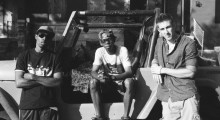
Michael Larnell grew his black-and-white debut feature Cronies through New York University’s Graduate Film program. Executive produced by NYU professor and project advisor Spike Lee, Larnell’s film follows three young men living in St. Louis as they discuss women, drugs, and other salacious topics of interest to innocently pass the time over a twenty-four hour period. A nonchalant, unassuming look at how men externalize their emotions, Cronies’ pleasures derive from its layered, amusing screenplay, documentary-inspired character interviews, and conflicted study of how far one will go to protect their brethren. As Cronies opens this Friday in IFP’s Screen Forward screening series, I spoke with Larnell about the decision […]
-
This Animated Documentary Won the IDA Award for Best Short
Last Day of Freedom is a hand-drawn animated documentary which chronicles Bill Babbitt’s relationship with his mentally ill brother, Manny, a Vietnam veteran with PTSD who was sentenced to the death penalty after murdering a woman. Using a confessional format to tell a compelling story encompassing the treatment of veterans, PTSD, mental illness, the criminal justice system, racism and family, the film won the Best Short Award at at the International Documentary Association’s IDA Awards Saturday night. Directed by Dee Hibbert-Jones and Nomi Talisman, Last Day of Freedom has taken top prizes at a number of festivals, including the Full Frame Documentary Film Festival, where it won the Jury […]
-
Why Ed Lachman Chose to Shoot Carol in Super 16mm
Carol is getting raves not just for Rooney Mara and Cate Blanchett’s subtle performances, but also for Ed Lachman’s cinematography, which was inspired by mid-century street photographers such as Ruth Orkin, Esther Bubley, Helen Levitt and Vivian Maier. In a first-person story for Indiewire, the veteran cinematographer, who has worked with Werner Herzog, Sofia Coppola, Todd Solondz, Robert Altman and Steven Soderbergh, writes about why he and director Todd Haynes chose to shoot the film in 16mm in order to achieve the look of 1952. “We wanted to reference the photographic representation of a different era,” Lachman said. “They can recreate grain digitally now, but […]
-
“I Don’t Want to Make Audiovisual Historical Aids”: Kent Jones on Hitchcock/Truffaut
The formal title of Hitchcock/Truffaut (alternately Hitchcock and The Cinema According to Alfred Hitchcock) is a vexed question mooted by its famous title design: Hitchcock’s name on one side, François Truffaut’s on the other. First published in 1966 and revised before Truffaut’s death, it’s one of the most commonly name-checked starter texts for anyone looking to learn more about film. In a series of extensive, probing and relatively unguarded conversations, Truffaut guides Hitchcock through his work film-by-film. Illustrated by numerous stills (including one- and two-page layouts showing every shot choice from particularly famous/intense sequences, breaking them down in a lucid, teachable way), the book allows a director in total command […]
-
“There is Really No Such Thing as Objectivity in Film or in Life”: Dan Rybicky and Aaron Wickenden on Almost There
“There was an aura of blunt truthfulness permeating his artwork, a sense of authenticity that really did pull us in” — Dan Rybicky and Aaron Wickenden on Almost There. If you met a mildly deranged looking outsider artist painting portraits at a pierogi festival in Indiana what would you do? Personally I would smile, possibly get my portrait made and then definitely go eat a pierogi. When filmmakers Dan Rybicky and Aaron Wickenden were presented with this scenario this is not what happened. Instead, they befriended the artist, their unlikely relationship slowly evolving into a layered folktale about creative expression […]
-
“A Chance to Develop Technique”: Oliver Stone on Talk Radio
From 1986 to 1995, writer-director Oliver Stone directed ten films in ten years which, taken together, comprise the most complex, provocative, and illuminating cinematic inquiry into American values since John Ford. The magnitude of his achievement seems virtually impossible in today’s Hollywood and was probably nearly as unlikely then. After a pair of powerful independent films exploring American foreign policy in Latin America (Salvador) and Vietnam (Platoon), Stone used the commercial success of the latter to harness studio resources at the service of a series of massively ambitious works, including an epic answer to and repudiation of the postwar mythology […]
-
“Observation of the Natural Behavior of Light”: By the Sea Cinematographer Christian Berger
Damaged by a personal tragedy and bludgeoned by 10 years of marriage, a blocked, alcoholic writer and his former dancer wife wallow in ennui at a remote seaside hotel in France circa 1970. It’s relatively heavy fare for movie stars the wattage of Brad Pitt and Angelina Jolie-Pitt, who also wrote and directed. But for By the Sea’s cinematographer Christian Berger, it’s practically a lighthearted romp compared to the subject matter of his many collaborations with director Michael Haneke, including Benny’s Video, Cache, and Berger’s Oscar-nominated work on The White Ribbon. There are certain perks that come with the Pitts’ […]
-
“Always Give Exposition While Running From a Bear”: Drew and John Erick Dowdle on No Escape
For the past few years I’ve been bemoaning the decline of the mid-range genre film, the action movie or horror flick that is neither a contained micro-budget opus straining against its resources nor an oppressive studio behemoth in which all sense of character, theme, and nuance is suffocated under the weight of its own scale and CGI. That mid-range has always been the source of many of America’s best, most enduring films; it’s the arena where masters like Don Siegel, Nicholas Ray, and Anthony Mann plied their trade under the classical studio system, and in more recent decades auteurs like […]
-
“As Far as I’m Concerned, We Are Making the Movie Version”: Sam Esmail on Mr. Robot
It remains unclear at what point this century cyberpunk — a science-fiction subgenre that emerged largely from the pens of William Gibson and Philip K. Dick — leapt from the realm of speculative to historical fiction; everywhere one looks, it seems that moment has arrived. Many (if not most) westerners live connected to a cyberpunk meta-narrative of their own making these days. We can all be certain, in the era of Edward Snowden, that our digital lives are being recorded. A dystopian view of computing and information technology’s potential, along with a skeptical eye toward vision of “technological as social progress” that corporate propagandists hurl […]